Resistance bands can add controlled overload to sprint drills, acceleration work, and lateral movement without requiring bulky equipment. The right setup should match your training level, available space, and preferred running mechanics.
We compared these 10 options by resistance, adjustability, comfort, portability, and suitability for speed-focused workouts so you can choose equipment that supports faster, more powerful movement.
Best 10 Resistance Bands for Running Speed Training Picks for 2026
Best Adjustable Leg-Band System
Kbands Speed and Strength Bands

- Padded, non-slip thigh straps
- Swivel clips support natural movement
- Includes digital speed and agility programs
Best For: Structured leg-resistance speed and agility training
Best Long-Range Bungee

- 33-foot training length
- 90-plus-pound resistance
- 360-degree movement with waist belt
Best For: Extended sprint drills in open training spaces
Best Multi-Level Leg Bands
Kinetic Bands Speed Training System

- Four color-coded resistance levels
- Swivel clips support full mobility
- Includes stretch strap and digital training
Best For: Progressive speed, agility, and conditioning programs
Best Versatile Bungee Set
Pseudois Running Training Band

- 20-foot stretch for dynamic resistance
- 360-degree rotating waist belt
- Includes door anchor for solo training
Best For: Portable sprint and multi-directional sport drills
Versatile Leg Resistance Set
11-Piece Speed & Agility Bands

- Four resistance levels from 10 to 30 pounds
- Includes leg straps and mesh carry bag
- Designed for leg, glute, agility, and strength work
Best For: Runners seeking adjustable lower-body band training
Explosive Sprint Trainer
80lb Running Resistance Bungee Set

- Up to 80 pounds of tensile strength
- Adjustable belt with two directional D-rings
- Includes anchor strap, cones, and carry bag
Best For: Resisted sprint and directional running drills
Multi-Directional Speed Kit
Acceleration Bungee Training System
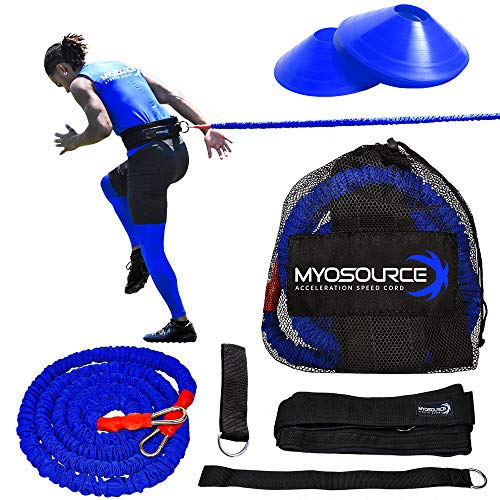
- Three belt sizes cover different waist ranges
- 360-degree D-ring supports directional training
- Includes speed cord, anchor strap, and eight cones
Best For: Multi-directional acceleration and agility sessions
Best Overall Setup

- 80 pounds of combined tension
- Includes belts, handles, and anchor strap
- Supports solo or partner training
Best For: Versatile speed, agility, and strength workouts
Best Lightweight Option

- About 40 pounds total tension
- Designed for sprint and agility drills
- Lightweight ankle-focused design
Best For: Compact leg and speed training
Best Guided Training Pick
360-Degree Running Bungee Band

- Supports multidirectional resistance drills
- Adjustable padded Velcro waist fit
- Includes V-Strength workout app
Best For: App-guided speed and agility workouts
Best Adjustable Leg-Band System – Kbands Speed and Strength Bands
Kbands are a strong option for athletes seeking resistance bands for running speed training with a focus on hip strength, acceleration, and agility. The padded, adjustable thigh straps and swivel clips are designed to support natural movement during lunges, squats, and multidirectional drills.
Best For: Athletes who want adjustable leg resistance, digital workouts, and multiple resistance options for speed and agility training.
Pros:
- Padded, non-slip thigh straps are designed to reduce rolling and slipping.
- Swivel clips provide mobility during movement-based exercises.
- Includes digital Speed 101, Agility FX, and other training programs.
- Available in resistance levels ranging from light youth options to advanced bands.
Cons:
- This listed set includes two resistance levels rather than the full range.
- The leg-strap format may be less suitable for users seeking a simple waist-belt trainer.
With its adjustable leg straps, compact travel bag, lifetime band warranty, and included digital training content, this set is geared toward structured speed and agility work rather than casual stretching.
Best Long-Range Bungee – MOVEMINT 33ft Speed Trainer
MOVEMINT 33ft Speed Bungee Band Trainer, 90+lbs Resistance (Longest in Market)
Check Price On AmazonThe MOVEMINT Speed Bungee is designed for resistance bands for running speed training when you need room to accelerate. Its 33-foot length, 90-plus-pound resistance, and 360-degree movement allow solo training when clipped to a stationary object or partner-based drills.
Best For: Runners and field-sport athletes who want a long bungee for extended sprint and movement drills.
Pros:
- 33-foot unit provides substantial travel distance for sprint training.
- Supports resistance of more than 90 pounds.
- Waist belt and 360-degree movement allow multidirectional work.
- Outer safety skin is intended to provide protection if the band snaps.
Cons:
- It has one resistance level, limiting adjustment options.
- At 1.9 pounds and 33 feet, it may require more setup space than leg bands.
This is a specialized choice for athletes with access to a secure anchor point or training partner. Its standout feature is range, making it better suited to open-field acceleration work than compact indoor exercises.
Best Multi-Level Leg Bands – Kinetic Bands Speed Training System
Kinetic Bands offer a versatile approach to resistance bands for running speed training, using leg straps and multiple resistance levels to challenge acceleration, balance, endurance, and sport-specific strength. The system is intended to preserve a natural range of motion during running and agility drills.
Best For: Athletes ages 13 and over who want several resistance levels and guided speed, agility, and fitness sessions.
Pros:
- Four resistance levels support progressive training.
- Swivel clips are designed for mobility during multidirectional drills.
- Includes adjustable leg straps, stretch strap, travel bag, and digital training access.
- Suitable for speed and agility, strength training, conditioning, and rehabilitation uses.
Cons:
- The listed configuration is intended for ages 13 and over.
- The system may offer more components than users seeking a minimal running accessory need.
For athletes who want progression rather than a single fixed load, this system provides a broad training package. Its four resistance levels and included digital series make it especially useful for planned conditioning programs.
Best Versatile Bungee Set – Pseudois Running Training Band
The Pseudois Resistance Bungee is a flexible choice for resistance bands for running speed training, combining an 8-foot nylon cord that stretches to 20 feet with a padded waist belt. Its rotating ring supports forward, lateral, and backward drills, while the included door anchor enables solo resistance work.
Best For: Runners and multi-sport athletes who need a portable bungee for partner drills or anchored home training.
Pros:
- 20-foot stretch length adds dynamic resistance to sprints, shuffles, and jumps.
- 360-degree rotation supports movement in multiple directions.
- Includes a padded adjustable waist belt and door anchor.
- Reinforced webbing, double stitching, and heavy-duty clips are built for repeated training.
Cons:
- It provides one medium resistance level.
- Solo use depends on a suitable door anchor or other secure setup.
This portable set is a practical middle ground between leg bands and longer field bungees. It works well for athletes who want one system for sprinting, lateral drills, jumps, and home-based resistance training.
Versatile Leg Resistance Set – 11-Piece Speed & Agility Bands
For runners comparing resistance bands for running speed training, this 11-piece set offers several lighter resistance options for sprint drills, leg workouts, and glute activation. It includes leg straps, four color-coded resistance levels, and a carry bag for organized storage.
Best For: Runners and athletes who want adjustable band resistance for leg strength, agility, and activation exercises.
Pros:
- Includes four resistance levels from 10 to 30 pounds.
- Comes with two leg straps for lower-body training.
- Includes a mesh carry bag for portability.
- Suitable for strength training, fitness, and multiple sports.
Cons:
- The listed tension range is limited to light resistance.
- It is a leg-band set rather than a belt-based resisted sprint system.
This is a flexible choice for runners who want to add banded leg and glute work to a broader training routine, especially when multiple resistance levels are more useful than a single sprint cord.
Explosive Sprint Trainer – 80lb Running Resistance Bungee Set
This bungee-based option is built for athletes looking for resistance bands for running speed training with resisted movement. The set combines an 8-foot natural-rubber band, adjustable waist belt, anchor strap, and cones, with up to 80 pounds of tensile strength and extension up to 22 feet.
Best For: Runners who want a compact resisted-sprint setup for solo, partner, directional, and cone-based drills.
Pros:
- Supports up to 80 pounds of tensile strength.
- Adjustable belt and two D-rings allow training in different directions.
- Can be used alone or with a coach or training partner.
- Includes two cones and a carry bag.
Cons:
- Provides one listed resistance level rather than multiple interchangeable levels.
- The set has a three-month warranty.
With its belt, anchor strap, and cones, this set is more focused on resisted running drills than general-purpose exercise bands. It is a practical fit for athletes who want an all-in-one speed-training kit.
Multi-Directional Speed Kit – Acceleration Bungee Training System
For athletes evaluating resistance bands for running speed training, this Kinetic Bands kit emphasizes acceleration, deceleration, and multi-directional resistance. It includes a speed cord, anchor strap, assistant hand strap, adjustable belt options, and eight stackable cones.
Best For: Runners and multi-sport athletes who want belt-based speed work in different directions, either solo or with a partner.
Pros:
- Available with small, medium, and large belt sizing.
- 360-degree D-ring supports movement in any direction.
- Offers both anchored solo training and partner resistance.
- Includes eight portable, stackable agility cones.
Cons:
- Lists one high-tension resistance level rather than adjustable levels.
- At 2.3 pounds, it is heavier than a basic set of loop bands.
This kit stands out for structured acceleration and agility sessions. Its multiple belt sizes and directional hardware make it a strong match for athletes who need a more specialized speed-training system.
Best Overall Setup – Dual Running Bungee Bands
If you want a versatile option among resistance bands for running speed training, this 8-piece dual-bungee set offers multiple ways to train. It includes two 40-pound ropes, adjustable waist belts, handles, and an anchor strap for solo or partner drills.
Best For: Runners and athletes who want adjustable, full-body speed, strength, agility, and jumping drills.
Pros:
- Provides 80 pounds of combined tension through two 40-pound resistance ropes.
- Includes waist belts, handles, and an anchor strap for varied training setups.
- Suitable for running, basketball, football, tennis, and other sports training.
Cons:
- The set has only two listed resistance levels.
- The ropes stretch up to 2.5 times their normal length, so users need adequate training space.
This is a strong all-around choice if you value training flexibility and a complete accessory package. Its dual-rope design supports both solo and coached workouts, while the included carry bag helps with storage and transport.
Best Lightweight Option – Ankle Speed Resistance Bands
These ankle bands are a compact choice for resistance bands for running speed training, especially when your routine centers on short sprints and agility drills. The two elastic ropes provide about 40 pounds of total tension and attach with heavy-duty clips.
Best For: Athletes seeking lightweight ankle resistance for sprint bursts, leg strengthening, agility work, and home workouts.
Pros:
- Designed to target the legs for running speed, mobility, endurance, and vertical jumping.
- Useful for short-burst sprints and dynamic agility drills.
- Lightweight construction weighs about 8 ounces and uses natural rubber latex.
Cons:
- Offers one listed resistance level rather than multiple levels.
- The notes do not list extra handles, belts, or anchors.
This model is practical for users who prefer a minimal, ankle-focused setup rather than a full harness system. Its lighter design makes it easier to add to home or sport-specific training sessions.
Best Guided Training Pick – 360-Degree Running Bungee Band
For athletes comparing resistance bands for running speed training, this waist-mounted bungee band emphasizes acceleration, agility, and speed-strength work. Its adjustable Velcro fit, padded construction, and 360-degree resistance design are paired with access to the V-Strength workout app.
Best For: Football and basketball athletes, runners, and users who want a padded waist band with app-supported workouts.
Pros:
- 360-degree resistance design supports multidirectional movement.
- Adjustable Velcro system and plush padding are intended to improve fit and comfort.
- Includes access to the V-Strength app and a storage bag.
Cons:
- Only one resistance level is listed, described as heavy.
- The notes do not specify a numerical tension rating.
This is a focused option for users who want a wearable resistance band rather than a multi-piece kit. The adjustable padded waist design and included app make it particularly appealing for structured speed and agility sessions.
How We Picked the Best Resistance Bands for Running Speed Training
We focused on equipment designed for resisted sprinting, acceleration drills, agility work, and lower-body strength rather than general-purpose fitness bands alone. Key considerations included resistance capacity, band length, attachment design, included waist belts or ankle cuffs, training adjustability, portability, and the quality of any instructional materials.
Because athletes have different goals, the list includes lighter ankle and leg-band systems, adjustable multi-band kits, and higher-resistance bungee trainers for advanced sprint and power work. Always inspect elastic and attachment points before use and follow the manufacturer’s setup instructions.
Quick Comparison
| What to Compare | Best For | What to Look For |
|---|---|---|
| Resistance level | Matching training intensity | Multiple levels or clearly stated pull resistance |
| Attachment system | Safe movement and fast setup | Secure clips, reinforced loops, cuffs, and waist belts |
| Band length | Track, field, or gym use | Enough travel for your drill area without excess slack |
| Included accessories | More varied workouts | Anchors, handles, straps, storage bags, or training guides |
Key Buying Factors for Resistance Bands for Running Speed Training
Resistance and Progression
Choose a resistance level that challenges acceleration without forcing you to shorten your stride or lean excessively. Beginners generally benefit from lighter resistance and gradual progression, while experienced athletes may prefer adjustable kits or stronger bungee systems. Multiple bands are useful because they allow warm-ups, technique practice, and heavier resisted runs with one setup.
Fit and Movement Freedom
A padded waist belt should sit securely without slipping, and ankle cuffs should stay comfortable during repeated drills. For leg-band systems, check whether the design encourages controlled hip, knee, and ankle movement rather than pulling you out of alignment. The best equipment lets you maintain sound sprint mechanics.
Length, Durability, and Safety
Longer bungees work well for resisted running when you have adequate space, but they require careful setup and a secure anchor or training partner. Look for durable latex or elastic construction, reinforced connection points, strong clips, and protective covers where provided. Avoid worn, cracked, or damaged bands, and leave sufficient clearance from people and obstacles.
Portability and Training Resources
If you train at multiple locations, prioritize compact kits with simple attachment systems and a storage bag. Digital programs or exercise guides can also help you organize sprint, agility, and strength sessions, especially if you are new to resisted running.
Who Should Buy Which Resistance Bands for Running Speed Training?
- Beginners: Choose a lighter, adjustable kit with clear instructions and comfortable cuffs or a waist belt.
- Sprinters and field-sport athletes: Look for progressive resistance, secure attachments, and enough length for acceleration and change-of-direction drills.
- Advanced power athletes: Consider higher-resistance bungee trainers, provided you have adequate space and strong sprint mechanics.
- Home and travel users: Select a portable multi-piece system that supports both resisted running and stationary strength exercises.
The best choice is the system you can set up safely, progress with consistently, and use without compromising running form.