A slam ball can add explosive power, core work, conditioning, and full-body strength training to a home workout without requiring much space. The best choice depends on more than weight alone: shell texture, bounce behavior, durability, and storage all affect how safely and effectively you can train.
We’ve gathered 10 strong options across multiple weights, materials, and designs to help you find a ball that matches your exercises, available room, and fitness level.
Best 10 Slam Balls for Home Gyms Picks for 2026
Heavy-Duty Tread Grip
ProsourceFit Slam Medicine Ball

- Treaded, non-slip PVC surface
- Sand-filled dead-weight design
- Available from 5 to 50 pounds
Best For: Progressive home-gym strength and conditioning
Jumbo Tacky Grip
Champion Sports Rhino ProMax Elite

- Tacky Rhino Skin vinyl exterior
- Large 14-inch ergonomic design
- More give and bounce than typical medicine balls
Best For: Dynamic throws, catches, and conditioning
Simple Dead-Weight Training
Amazon Basics Slam Medicine Ball

- 15-pound sand-filled core
- Textured non-slip PVC surface
- Designed to minimize bouncing
Best For: HIIT, CrossFit, and controlled home workouts
Rugged Tread Performance

- Sand-filled non-bounce construction
- Sweat-resistant tread grip
- 10- to 50-pound weight range
Best For: Adaptable full-body conditioning at home
Wall-Ball Specialist
Champion Sports Rhino Promax 12 lb

- 12-pound soft-shell wall ball
- 14-inch diameter for consistent form
- Grip-focused design with double-stitched seams
Best For: Wall balls, partner drills, and functional fitness
Simple Rubber Option
Amazon Basics 12-Pound Medicine Ball

- Firm 12-pound rubber construction
- Lightly textured grip and labeled weight
- Supports tosses, twists, squats, and sit-ups
Best For: General-purpose home medicine-ball workouts
Most Versatile Option
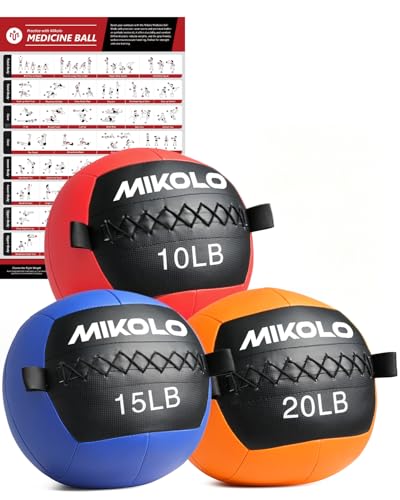
- Three-ball, multi-weight setup
- Wide finger loop for secure handling
- Includes wall-mountable exercise chart
Best For: Mixed home workouts and users wanting multiple weights
Best Lightweight Starter

- Beginner-friendly 4-pound weight
- Textured surface supports grip
- No-bounce sand-filled core
Best For: Technique practice, core work, and lighter conditioning
Best Midweight Training Pick

- Moderate 8-pound training load
- Grippy sand-textured exterior
- Dead-weight core limits bounce and roll
Best For: Intermediate strength and conditioning workouts
Heavy-Duty Tread Grip – ProsourceFit Slam Medicine Ball
For home gyms seeking versatile slam balls for home gyms, the ProsourceFit model combines a rugged tread surface with a sand-filled, non-bouncing design. It is available in weights from 5 to 50 pounds, making it suitable for progressive strength, conditioning, and core work.
Best For: Home-gym users who want strong grip, controlled dead-weight slams, and multiple weight options for different training levels.
Pros:
- Textured tire-tread surface helps provide traction during sweaty workouts.
- Sand-filled construction minimizes bouncing and rolling.
- Durable waterproof PVC shell is designed for repeated impact.
- Available from 5 to 50 pounds for beginner through advanced training.
Cons:
- The dead-weight design may feel heavier than traditional weights.
- Heavier versions can require careful technique and adequate training space.
Its broad weight range and predictable non-bounce behavior make this a practical choice for building a home-gym slam-ball setup gradually. Beginners may want to start with the recommended 10- to 15-pound range.
Jumbo Tacky Grip – Champion Sports Rhino ProMax Elite
The Champion Sports Rhino ProMax Elite offers a larger 14-inch format and a tacky vinyl exterior for controlled handling. Among slam balls for home gyms, it stands out for users who want a ball that offers more give and bounce than typical medicine fitness balls.
Best For: Home-gym athletes who prioritize a large, comfortable grip for throws, catches, slams, cardio, and core training.
Pros:
- Rhino Skin tacky vinyl exterior supports a controlled, non-slip grip.
- Large ergonomic build is designed for throwing, catching, and slamming.
- Built for repeated impact and significant wear-and-tear.
- Can add full-body training to aerobic activity, weightlifting, or cross-training.
Cons:
- Its 8-pound size may not meet the needs of users seeking heavier resistance.
- It offers more bounce than a traditional dead-weight slam ball.
- Coverage is voided by repeated impact on rough surfaces or ground slams from overhead.
This is a useful option when grip and handling matter more than a strict no-bounce response. Its lighter weight and larger diameter also suit dynamic conditioning work.
Simple Dead-Weight Training – Amazon Basics Slam Medicine Ball
Amazon Basics Heavy-Duty Slam Medicine Ball for Exercise, Weighted Design, 15lb, Black
Check Price On AmazonThe Amazon Basics Slam Medicine Ball is a straightforward choice for slam balls for home gyms, pairing a sand-filled core with heavy-duty PVC construction. Its textured surface and dead-weight design support controlled slams, HIIT, CrossFit, and strength-training movements.
Best For: Home-gym users who want a 15-pound slam ball for core strength, explosive power, and cardiovascular conditioning.
Pros:
- Heavy-duty PVC construction is designed to absorb powerful impacts.
- Sand-filled core helps prevent unwanted bouncing.
- Textured surface supports grip during sweaty training sessions.
- Balanced weight distribution suits controlled and dynamic exercises.
Cons:
- Only a 15-pound size is specified in the supplied product details.
- The fixed weight offers less flexibility than multi-weight product ranges.
With its focused 15-pound configuration, this ball is a practical fit for buyers who already know the resistance they want. Its dead-weight construction is especially useful where predictable floor contact matters.
Rugged Tread Performance – MARCY Slam Ball
The MARCY Slam Ball uses a sand-filled PVC construction to absorb impact while its rugged tread texture helps maintain control. For shoppers comparing slam balls for home gyms, its selection of 10- to 50-pound weights supports both entry-level conditioning and heavier power work.
Best For: Home-gym users who want a non-bouncing ball with a sweat-resistant grip and a broad range of available weights.
Pros:
- Dead-weight design helps prevent bouncing and rolling.
- Durable PVC outer shell is built for repeated high-intensity training.
- Rugged tread texture provides a non-slip, sweat-resistant grip.
- Available in weights from 10 to 50 pounds.
Cons:
- Each weight is sold individually.
- Heavier options may be demanding for beginners and require controlled technique.
The MARCY is a strong fit for households that want to choose a specific training load rather than buy a fixed-weight ball. Its non-bounce profile and broad range make it adaptable as strength and conditioning goals change.
Versatile Pick – Champion Sports Leather Medicine Ball
If you want slam balls for home gyms that can also support broader strength and conditioning work, this 9-pound Champion Sports medicine ball is a flexible option. Its synthetic-leather exterior is designed for a controlled grip, while reinforced stitching adds durability for lifting, throwing, and other training movements.
Best For: Home-gym users who want a multipurpose weighted ball for strength training, core work, aerobics, Pilates, yoga, and cross-training.
Pros:
- Supple synthetic-leather surface helps maintain grip, including during sweaty workouts.
- Reinforced stitching supports long-lasting use.
- Useful across strength, core, conditioning, and mixed fitness routines.
- 9-pound weight offers a manageable challenge for many exercises.
Cons:
- It is described as a medicine ball rather than a slam-specific ball.
- The 9-pound model may not provide enough resistance for advanced users seeking heavier loading.
Choose this model when versatility matters more than a specialized slam-ball design. Its grip and construction make it practical for varied home workouts, but buyers focused mainly on repeated slams should review the product’s intended use carefully.
Wall-Ball Specialist – Champion Sports Rhino Promax 12 lb
For shoppers comparing slam balls for home gyms with wall-ball equipment, the Champion Sports Rhino Promax emphasizes grip, impact absorption, and consistent handling. This 12-pound model has a 14-inch diameter and a double-stitched soft shell for wall throws, partner drills, and functional strength work.
Best For: Home-gym athletes focused on wall balls, squats, presses, partner exercises, and conditioning drills.
Pros:
- Rhino Skin faux-leather shell provides a comfortable, controlled grip.
- Double-stitched seams and cushioned construction support repeated training.
- Uniform 14-inch diameter helps maintain technique as resistance changes.
- 12-pound weight suits strength and conditioning sessions.
Cons:
- The supplied notes specifically state that it is not intended for slamming exercises.
- Its 14-inch size may require more storage space than a compact medicine ball.
This is a strong fit for wall-ball programming rather than a true slam-ball routine. The soft shell, grip, and consistent diameter make it useful for controlled throws and functional training, but the stated no-slamming limitation is important for buyers seeking dedicated slam work.
Simple Rubber Option – Amazon Basics 12-Pound Medicine Ball
This Amazon Basics 12-pound medicine ball is a straightforward choice for home gyms building a general-purpose training setup. Its firm rubber construction, lightly textured surface, clearly marked weight, and ability to bounce off hard surfaces support classic medicine-ball movements such as tosses, twists, squats, and sit-ups.
Best For: Users seeking a clearly labeled 12-pound ball for core strength, balance, coordination, and full-body medicine-ball exercises.
Pros:
- Sturdy, firm rubber construction is suited to regular medicine-ball workouts.
- Lightly textured surface provides a practical grip.
- Weight is clearly labeled on both sides.
- Can bounce off hard surfaces for added exercise variety.
Cons:
- It is a medicine ball, not specifically described as a slam ball.
- The firm rubber design may be less comfortable than a soft-shell ball for some throwing drills.
- At 9.3 inches in diameter, it may feel different from larger wall-ball models.
Consider this model if you want an uncomplicated, clearly marked medicine ball for everyday home training. It supports a broad range of movements and bouncing exercises, though dedicated slam-ball buyers should distinguish its general-purpose design from equipment specifically made for slams.
Most Versatile Option – Mikolo Soft Medicine Ball Set
For shoppers comparing slam balls for home gyms, the Mikolo set stands out as a flexible multi-ball option for strength, core, wall-ball, and functional training. Its soft padded construction and wide finger loop support controlled handling during tosses, lifts, and slams.
Best For: Home gym users who want multiple weights and a broad range of exercises.
Pros:
- Includes three balls in a multi-weight setup, with listed options spanning 10, 15, 20, and 25 pounds.
- Wide nylon finger loop provides additional grip space for dynamic movements.
- Dual-layer PVC and mesh construction, reinforced stitching, and inner sponge padding are designed for durability and softer impact.
- Includes a wall-mountable A4 exercise chart covering arms, core, legs, and more.
Cons:
- The larger 14-inch size may require more storage space than a compact slam ball.
- Its soft, padded design may not suit shoppers seeking a firm, traditional dead-weight ball.
The Mikolo is a practical choice when variety matters more than a single specialized training weight. Its included guidance and grip-focused design also make it approachable for beginners and useful for mixed household workouts.
Best Lightweight Starter – REP 4-Lb Weighted Slam Ball
Among slam balls for home gyms, this 4-pound REP model is a manageable entry point for conditioning, core work, and technique practice. Its textured surface and sand-filled, no-bounce construction help keep movements controlled in smaller workout areas.
Best For: Beginners and home exercisers who prefer a lighter ball for foundational training.
Pros:
- Light 4-pound weight is suited to beginner-friendly training and higher-repetition work.
- Soft, sand-textured PVC surface supports a secure grip during sweaty workouts.
- Sand-filled dead-weight design minimizes bounce and roll after slams.
- Hand-stitched synthetic leather construction uses double-reinforced seams.
Cons:
- The lightweight design may provide limited challenge for advanced strength athletes.
- This listing is for one ball rather than a multi-weight set.
The REP 4-pound ball is a sensible starting option for learning slam mechanics, adding core work to circuits, or training in a shared space where predictable ball behavior is useful.
Best Midweight Training Pick – REP 8-Lb Weighted Slam Ball
This 8-pound REP ball offers a moderate loading option for shoppers choosing slam balls for home gyms. It is built for full-body slams, throws, and conditioning, while the textured cover and dead-weight core support consistent handling during repeated sets.
Best For: Intermediate home gym users who want more resistance than a beginner ball without moving to a heavy model.
Pros:
- 8-pound weight provides a versatile middle ground for strength, core, and conditioning sessions.
- Sand-textured surface helps maintain grip during fast or sweaty workouts.
- No-bounce sand-filled core minimizes rolling and keeps the ball in place after impact.
- Double-stitched synthetic leather cover is designed for repeated training use.
Cons:
- At 14 inches, the ball may be bulky for limited storage areas.
- As a single-weight ball, it does not provide the progression of a complete set.
The 8-pound REP is a balanced pick for home athletes who have moved beyond very light resistance and want one dependable ball for circuits, CrossFit-style conditioning, and core-focused sessions.
How We Picked the Best Slam Balls for Home Gyms
We evaluated these slam balls by looking at the features that matter most for home training: available weight ranges, grip texture, shell construction, bounce resistance, durability, and versatility. We also considered whether each design is better suited to repeated floor slams, wall work, loaded carries, core exercises, or general conditioning.
Because home gyms vary widely, the roundup includes both lighter options for beginners and faster-paced workouts and heavier models for strength-focused training. Soft-shell and textured designs can also be useful when noise, comfort, or handling matters.
Quick Comparison
| What to Compare | Best For |
|---|---|
| 5–10 pounds | Beginners, speed work, and conditioning circuits |
| 12–20 pounds | General strength, rotational work, and repeated slams |
| 25–50 pounds | Advanced users, loaded movements, and slower power work |
| Textured grip | Secure handling during sweaty workouts |
| Soft or sand-filled shell | More comfortable catches and reduced bounce |
Key Buying Factors for Slam Balls for Home Gyms
Weight
Choose a weight that lets you perform powerful, controlled repetitions without losing form. A lighter ball is usually better for overhead slams, rotational throws, and high-repetition circuits. Heavier balls work well for slower slams, squats, carries, and strength-focused movements, but they demand more control.
Shell and Grip
Look for a textured or non-slip exterior if you expect to train with sweaty hands. Rubberized shells are commonly suited to hard floor slams, while softer shells may feel better for catches, partner work, and wall exercises. Always verify that the ball is designed for the surface and movement you plan to use.
Bounce and Durability
A dead-weight or non-bounce design is often easier to control in a home gym because it stays near the landing point. Check the manufacturer’s usage guidance, especially if you train on concrete, asphalt, or other abrasive surfaces. A durable ball still benefits from a protective mat and appropriate storage.
Size and Storage
A larger soft ball can be easier to catch but may be less convenient in a compact room. Consider where you will store it and whether you need one fixed weight or a set that supports progression.
Who Should Buy Which Slam Balls for Home Gyms?
Beginners: Start with a 5- to 10-pound ball that has a dependable grip and manageable size. This range supports technique practice without making every movement overly taxing.
General home-gym users: A 10- to 20-pound textured, non-bounce ball offers a useful balance for slams, core exercises, conditioning, and full-body strength work.
Advanced athletes: Consider a 20-pound-and-up model for loaded carries, heavy slams, and power training, provided you have adequate space and a suitable floor surface.
Noise-conscious households: Favor soft-shell or sand-filled designs and use a thick training mat to reduce impact noise and protect both the ball and floor.