Treadmill vs. outdoor running is one of the most searched comparisons in endurance training, and the research shows that the answer is nuanced rather than absolute. A motorized treadmill can replicate outdoor running surprisingly well for many physiological variables, especially when a 1% incline is used, but outdoor running still tends to have advantages in endurance transfer, environmental variability, and some training adaptations.
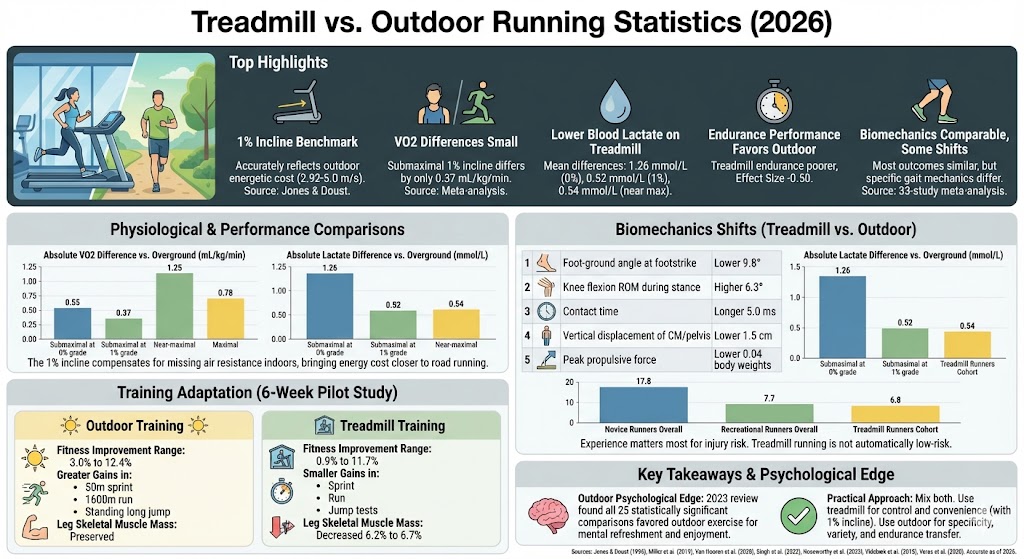
This statistics roundup focuses on the numbers that matter most: energy cost, VO2, lactate, biomechanics, performance, injury incidence, and outdoor vs. indoor exercise outcomes.
Treadmill vs. Outdoor Running Statistics (Top Highlights)
- 1% treadmill incline is the classic benchmark: a controlled study found that a 1% grade most accurately reflected the energetic cost of outdoor running across speeds of 2.92 to 5.0 m/s.
- VO2 differences are usually small: a 34-study meta-analysis found submaximal motorized treadmill running at 1% grade differed from overground running by only 0.37 mL/kg/min in oxygen uptake.
- Blood lactate tends to be lower on treadmills: mean differences were 1.26 mmol/L lower at 0% grade, 0.52 mmol/L lower at 1% grade, and 0.54 mmol/L lower near maximal speeds.
- Endurance performance often favors overground running: treadmill endurance performance was poorer in the main meta-analysis, with an effect size of -0.50.
- Sprint performance is less clear: sprint performance was not significantly different overall in the same review.
- Most biomechanics are comparable: a 33-study biomechanics meta-analysis covering 494 participants found that most outcomes did not differ between motorized treadmill and overground running.
- Some gait mechanics do shift: on treadmills, foot-ground angle at footstrike was 9.8° lower, knee flexion ROM during stance was 6.3° higher, and contact time was 5.0 ms longer.
- Outdoor training may transfer better: in a 6-week pilot study of 28 recreationally active young men, both treadmill and outdoor groups improved fitness and reduced fat percentage, but outdoor running produced larger gains in 50 m sprint, 1,600 m run, and standing long jump.
- Outdoor exercise shows a psychological edge in broader research: a 2023 systematic review identified 99 comparisons between outdoor and indoor exercise, and all 25 statistically significant comparisons favored outdoor exercise.
- Experience matters for injury risk: a running injury meta-analysis found 17.8 injuries per 1,000 hours in novice runners versus 7.7 per 1,000 hours in recreational runners.
- A treadmill-specific prospective cohort reported 6.8 injuries per 1,000 hours, putting treadmill injury incidence in the same general range as broader recreational running estimates.
Treadmill vs. Outdoor Running Chart (Absolute VO2 Difference vs. Overground)
| Label | Bar | Value | ||
|---|---|---|---|---|
| Submaximal treadmill at 0% grade |
| 0.55 mL/kg/min | ||
| Submaximal treadmill at 1% grade |
| 0.37 mL/kg/min | ||
| Near-maximal treadmill running |
| 1.25 mL/kg/min | ||
| Maximal treadmill running |
| 0.78 mL/kg/min |
Max = 1.25 mL/kg/min. Widths: Submaximal treadmill at 0% grade 44.00%, Submaximal treadmill at 1% grade 29.60%, Near-maximal treadmill running 100.00%, Maximal treadmill running 62.40%.
How Close Is Treadmill Running to Outdoor Running?
The best single-number summary is that treadmill running is usually close, but not always identical. The classic Jones and Doust study remains influential because it showed that adding a 1% incline compensates for the missing air resistance indoors and brings the energy cost of treadmill running much closer to road running.
The larger meta-analysis by Miller and colleagues adds more context. It found that oxygen uptake on a motorized treadmill was broadly similar to overground running, particularly at 1% grade, but not every variable matched perfectly. Blood lactate was often lower on the treadmill, and endurance performance tended to be worse on the treadmill than outdoors.
| Measure | Treadmill vs. overground result | Main number |
|---|---|---|
| Submaximal VO2 at 0% grade | Very similar | -0.55 mL/kg/min |
| Submaximal VO2 at 1% grade | Very similar | +0.37 mL/kg/min |
| Near-maximal VO2 | Treadmill lower | -1.25 mL/kg/min |
| Maximal VO2 | Essentially similar | +0.78 mL/kg/min |
| Max heart rate | Essentially similar | -1 bpm |
| Endurance performance | Outdoor better | SMD -0.50 |
Treadmill vs. Outdoor Running Chart (Absolute Lactate Difference vs. Overground)
| Label | Bar | Value | ||
|---|---|---|---|---|
| Submaximal treadmill at 0% grade |
| 1.26 mmol/L | ||
| Submaximal treadmill at 1% grade |
| 0.52 mmol/L | ||
| Near-maximal treadmill running |
| 0.54 mmol/L |
Max = 1.26 mmol/L. Widths: Submaximal treadmill at 0% grade 100.00%, Submaximal treadmill at 1% grade 41.27%, Near-maximal treadmill running 42.86%.
Biomechanics Statistics: What Actually Changes?
The biomechanics literature is often summarized too aggressively. The more accurate summary is that most mechanics stay similar, but several specific variables shift enough to matter for coaching, rehab, or gait analysis.
In the 2020 biomechanics meta-analysis, the largest pooled differences were a 9.8° lower sagittal foot-ground angle at footstrike, a 6.3° higher knee flexion ROM during stance, a 1.5 cm lower vertical displacement of the center of mass or pelvis, a 0.04 body-weight lower peak propulsive force, and a 5.0 ms longer contact time on the treadmill.
| Biomechanical metric | Treadmill direction | Mean difference |
|---|---|---|
| Foot-ground angle at footstrike | Lower | 9.8° |
| Knee flexion ROM during stance | Higher | 6.3° |
| Contact time | Longer | 5.0 ms |
| Vertical displacement of center of mass or pelvis | Lower | 1.5 cm |
| Peak propulsive force | Lower | 0.04 body weights |
Performance and Training Adaptation Statistics
For athletes and regular runners, the practical question is not only whether treadmill and outdoor running feel similar, but whether they produce the same adaptation. The answer is not perfectly.
The Miller review found that endurance performance was poorer on a motorized treadmill, even though many physiological measures were close. That matters because small environmental and mechanical differences can accumulate over longer efforts.
The 6-week pilot study helps explain why. Both the treadmill and outdoor groups improved fitness and reduced body fat percentage, but outdoor training was better for sprint time, 1,600 m run performance, and standing long jump. The outdoor group improved physical fitness variables by 3.0% to 12.4%, while the treadmill group improved by 0.9% to 11.7%. The treadmill group also showed a 6.2% to 6.7% decrease in leg skeletal muscle mass, while outdoor training preserved it.
| Study finding | Outdoor running | Treadmill running |
|---|---|---|
| Fitness improvement range | 3.0% to 12.4% | 0.9% to 11.7% |
| 50 m sprint | Favored | Improved, but less |
| 1,600 m run | Favored | Improved, but less |
| Standing long jump | Favored | Improved, but less |
| Leg skeletal muscle mass | Preserved | Down 6.2% to 6.7% |
Injury Statistics and Risk Context
There is still less direct treadmill-vs-outdoor injury data than many runners assume, so the cleanest way to read the evidence is to compare a treadmill-specific cohort with broader running injury benchmarks.
A prospective treadmill-running study reported 6.8 injuries per 1,000 hours of exposure. In the broader running injury meta-analysis, recreational runners averaged 7.7 injuries per 1,000 hours and novice runners averaged 17.8 per 1,000 hours. That suggests treadmill running is not automatically low-risk, but beginner status appears to be a much bigger injury driver than simply choosing indoors or outdoors.
Treadmill vs. Outdoor Running Chart (Injury Incidence Benchmarks per 1,000 Hours)
| Label | Bar | Value | ||
|---|---|---|---|---|
| Treadmill runners cohort |
| 6.8 | ||
| Recreational runners overall |
| 7.7 | ||
| Novice runners overall |
| 17.8 |
Max = 17.8. Widths: Treadmill runners cohort 38.20%, Recreational runners overall 43.26%, Novice runners overall 100.00%.
Mental and Behavioral Statistics
The psychological picture is less settled than the physiology, but outdoor exercise keeps showing enough positive signals to matter. In the 2023 systematic review of longitudinal outdoor-vs-indoor exercise trials, researchers found 10 eligible trials with 343 participants. Across those trials, there were 99 comparisons between outdoor and indoor exercise, and all 25 statistically significant comparisons favored outdoor exercise.
That does not prove outdoor running is always better, because the authors also reported high risk of bias and substantial heterogeneity. Still, it does support the common real-world observation that outdoor exercise can be easier to enjoy, repeat, and mentally refresh from.
Key Takeaways
- Choose treadmill running when you need control over pace, incline, weather, traffic, terrain, or rehab conditions.
- Choose outdoor running when you want better specificity for races, more environmental variability, and potentially stronger transfer to real-world endurance performance.
- Use a 1% incline when trying to make steady treadmill running feel more like outdoor road running.
- Do not assume treadmill means injury-proof; the available numbers suggest training history and runner experience still matter more.
- The most practical approach for many runners is mixed use: treadmill for precision and convenience, outdoor running for specificity and variety.
Sources
- Jones AM, Doust JH. A 1% treadmill grade most accurately reflects the energetic cost of outdoor running. Journal of Sports Sciences, 1996. https://pubmed.ncbi.nlm.nih.gov/8887211/
- Miller JR, Van Hooren B, Bishop C, et al. A Systematic Review and Meta-Analysis of Crossover Studies Comparing Physiological, Perceptual and Performance Measures Between Treadmill and Overground Running. Sports Medicine, 2019. https://pubmed.ncbi.nlm.nih.gov/30847825/
- Van Hooren B, Fuller JT, Buckley JD, et al. Is Motorized Treadmill Running Biomechanically Comparable to Overground Running? Sports Medicine, 2020. https://pubmed.ncbi.nlm.nih.gov/31802395/
- Singh G, Kushwah G, Singh T, Ramírez-Campillo R, Thapa RK. Effects of six weeks outdoor versus treadmill running on physical fitness and body composition in recreationally active young males: a pilot study. PeerJ, 2022. https://pmc.ncbi.nlm.nih.gov/articles/PMC9338755/
- Noseworthy M, Peddie L, Buckler EJ, et al. The Effects of Outdoor versus Indoor Exercise on Psychological Health, Physical Health, and Physical Activity Behaviour: A Systematic Review of Longitudinal Trials. International Journal of Environmental Research and Public Health, 2023. https://pmc.ncbi.nlm.nih.gov/articles/PMC9914639/
- Videbæk S, Bueno AM, Nielsen RO, Rasmussen S. Incidence of Running-Related Injuries Per 1000 h of running in Different Types of Runners: A Systematic Review and Meta-Analysis. Sports Medicine, 2015. https://pubmed.ncbi.nlm.nih.gov/25951917/
- Veras PM, Moreira N, Morais GA, et al. Incidence of injuries and associated factors in treadmill runners: a prospective cohort study. Motriz, 2020. https://www.scielo.br/j/motriz/a/SmnjTnhJjF6RVp39PmRQcjx/?lang=en