Treadmill weight loss statistics show that the machine itself is not the magic factor. The real driver is how consistently people use a treadmill to accumulate enough weekly aerobic volume, intensity, and progression.
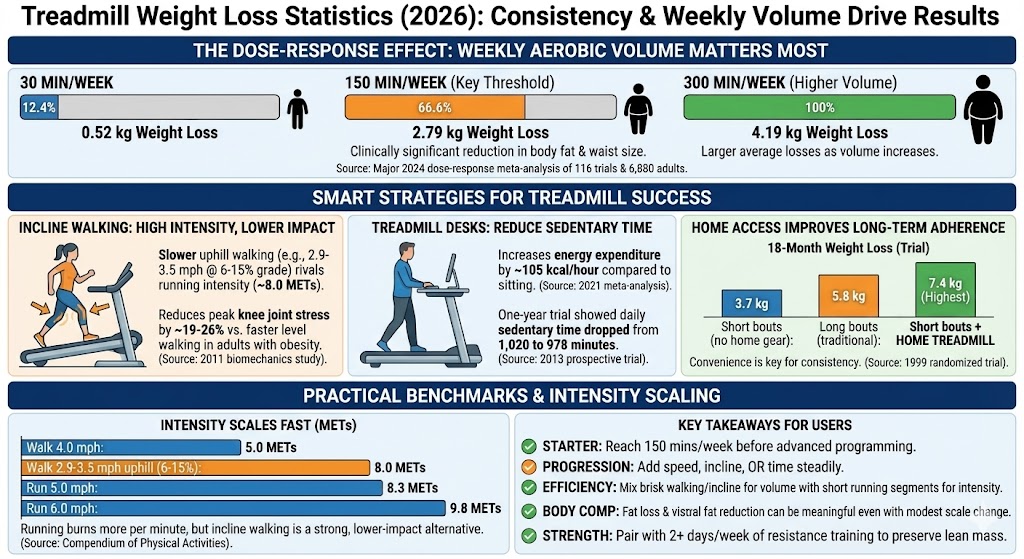
The strongest recent evidence suggests that treadmill walking and running work best for weight loss when they help people reach at least 150 minutes of moderate-intensity cardio per week, with larger average losses showing up as exercise volume increases toward 300 minutes weekly.
Treadmill Weight Loss Statistics (Top Highlights)
- 116 randomized trials and 6,880 adults: A major 2024 dose-response meta-analysis found that aerobic exercise reduced body weight, waist size, and body fat in adults with overweight or obesity.
- Every extra 30 minutes per week mattered: Each added 30 minutes of aerobic exercise per week was associated with 0.52 kg lower body weight, 0.56 cm lower waist circumference, and 0.37 percentage points lower body fat.
- 150 minutes per week is the key threshold: The same analysis found that 150 minutes per week of moderate-to-vigorous aerobic exercise was associated with clinically important reductions in waist circumference and body fat.
- Average weight loss rose with higher volume: Estimated weight reduction reached 2.79 kg at 150 minutes per week and 4.19 kg at 300 minutes per week.
- Body-fat reduction peaked early: Body fat percentage fell by 2.08 percentage points at 150 minutes per week, enough to clear the study’s threshold for a clinically important change.
- Waist losses were meaningful at higher volumes: At 300 minutes per week, waist circumference fell by 4.21 cm with moderate-intensity exercise and 5.34 cm with moderate-to-vigorous exercise.
- Exercise-only weight loss is usually modest but real: An overview of 12 systematic reviews and 149 studies found exercise programs typically produced 1.5 to 3.5 kg of weight loss and 1.3 to 2.6 kg of fat loss in adults with overweight or obesity.
- Visceral fat can drop even without big scale changes: The same review reported visceral fat reductions large enough to matter for cardiometabolic health, with losses sometimes reaching 30 to 40 cm².
- Treadmill desks raise calorie burn during sedentary time: A meta-analysis of 13 studies with 351 participants found treadmill desks increased energy expenditure by 105.23 kcal per hour compared with sitting.
- A one-year treadmill-desk trial showed measurable weight change: In a prospective trial, overall weight loss averaged 1.4 kg, while participants with obesity lost 2.3 kg on average.
- Sedentary time dropped with treadmill desks: Daily sedentary time fell from 1,020 minutes per day at baseline to 929 minutes at 6 months and 978 minutes at 12 months.
- Home treadmill access improved long-term results: In an 18-month randomized trial of 148 sedentary overweight women, the short-bout exercise group with a home treadmill lost 7.4 kg, versus 3.7 kg in the short-bout group without equipment.
- Traditional longer sessions also worked: In the same trial, the long-bout exercise group lost 5.8 kg on average by 18 months.
- Incline treadmill walking can reduce joint stress: In adults with obesity, slower uphill treadmill walking produced moderate-intensity effort at 48.5% to 59.8% of VO2max while reducing peak knee extension moments by about 19% and knee adduction moments by about 26% versus faster level walking.
- Treadmill intensity scales fast: The Compendium of Physical Activities rates 4.0 mph walking at 5.0 METs, 5.0 mph running at 8.3 METs, and 6.0 mph running at 9.8 METs.
- Incline walking can rival running intensity: Walking at 2.9 to 3.5 mph uphill at a 6% to 15% grade is rated at 8.0 METs, close to easy running.
- Calorie burn rises sharply with speed: Harvard Health estimates that a 155-pound adult burns about 175 calories in 30 minutes walking at 4 mph and about 288 calories in 30 minutes running at 5 mph.
- Higher body weight usually means higher calorie burn: In the same Harvard table, a 185-pound adult burns about 189 calories walking 4 mph for 30 minutes and 336 calories running 5 mph for 30 minutes.
- Public-health guidance matches the weight-loss floor: CDC guidance calls for at least 150 minutes of moderate activity or 75 minutes of vigorous activity weekly, plus 2 days of muscle-strengthening work.
- The need is massive: WHO reports that in 2022, 43% of adults worldwide were overweight and 16% were living with obesity.
Estimated Weight Loss by Weekly Aerobic Volume
The most useful treadmill statistic for weight loss is not speed alone. It is the amount of weekly aerobic work a person can sustain. The 2024 dose-response meta-analysis showed a clear pattern: more weekly aerobic exercise generally meant more weight loss, with 150 minutes per week acting as the first meaningful threshold and 300 minutes per week producing larger average losses.
| Label | Bar | Value | ||
|---|---|---|---|---|
| 30 min/week |
| 0.52 kg | ||
| 150 min/week |
| 2.79 kg | ||
| 300 min/week |
| 4.19 kg |
Max = 4.19 kg. Widths: 30 min/week 12.41%, 150 min/week 66.59%, 300 min/week 100.00%
Home Treadmills Improve Adherence and Long-Term Weight Loss
One of the hardest parts of weight loss is staying consistent long enough for the calories to add up. That is where treadmills often outperform more complicated routines. A long-running randomized trial showed that short exercise bouts paired with home treadmill access produced the best average 18-month weight loss of the three exercise formats tested.
| Label | Bar | Value | ||
|---|---|---|---|---|
| Short bouts |
| 3.7 kg | ||
| Long bouts |
| 5.8 kg | ||
| Short bouts + home treadmill |
| 7.4 kg |
Max = 7.4 kg. Widths: Short bouts 50.00%, Long bouts 78.38%, Short bouts + home treadmill 100.00%
Treadmill Intensity Statistics
Treadmills are useful because intensity can be scaled with speed and incline in small, repeatable steps. That makes them practical for beginners trying to create a calorie deficit, but also for advanced users who want more intensity without needing outdoor conditions to cooperate.
The Compendium of Physical Activities helps show how quickly treadmill sessions become demanding. A brisk 4 mph walk is already moderate-to-vigorous for many people, while incline walking can approach the workload of easy running. This matters because some users can get close to running-level intensity without the same pace-related impact.
| Label | Bar | Value | ||
|---|---|---|---|---|
| Walk 4.0 mph |
| 5.0 METs | ||
| Walk 2.9-3.5 mph uphill (6%-15%) |
| 8.0 METs | ||
| Run 5.0 mph |
| 8.3 METs | ||
| Run 6.0 mph |
| 9.8 METs |
Max = 9.8 METs. Widths: Walk 4.0 mph 51.02%, Walk 2.9-3.5 mph uphill (6%-15%) 81.63%, Run 5.0 mph 84.69%, Run 6.0 mph 100.00%
What the Numbers Mean for Treadmill Users
The most important treadmill weight loss statistic is that consistency beats intensity spikes. A treadmill makes it easier to repeat sessions, track weekly minutes, and steadily add speed or incline over time. That matters because the evidence base shows a clear dose-response curve: people usually lose more weight as aerobic volume climbs.
For many adults, the first realistic target is 150 minutes per week. On a treadmill, that could mean 30 minutes across five days, or shorter sessions split across the day. If weight loss stalls, the next adjustment is often to push total weekly volume toward 225 to 300 minutes, rather than chasing all-out intensity every session.
Incline walking is especially interesting because it raises workload without requiring fast running speeds. In people with obesity, slower uphill treadmill walking has been shown to keep exercise in a moderate-intensity zone while lowering knee loading compared with faster level walking. That makes it a strong option for beginners, heavier users, and anyone managing impact discomfort.
Treadmill desks are different from formal workouts, but they matter too. Their value is not huge single-session calorie burns. Their value is that they reduce sitting time and add low-level movement to hours that would otherwise be completely sedentary. Over months, that can support weight management and help protect against the “all day sitting, short workout” pattern.
Calorie-burn tables also reinforce why running tends to produce faster scale changes than walking when time is matched. But walking remains powerful because it is easier to recover from, easier to repeat, and easier to scale up in total weekly duration. In practice, many successful treadmill weight loss routines mix the two: brisk walking or incline walking for volume, and short running segments for intensity.
Practical Treadmill Weight Loss Benchmarks
- Starter benchmark: Reach 150 treadmill minutes per week before worrying about advanced programming.
- Progression benchmark: Add either speed, incline, or total time, but usually not all three at once.
- Efficiency benchmark: Running burns more calories per minute, but incline walking can approach running-level intensity with lower impact.
- Adherence benchmark: Keeping a treadmill at home or within easy reach can improve long-term consistency.
- Body-composition benchmark: Even when total weight loss looks modest, fat loss and visceral-fat reduction can still be meaningful.
- Strength benchmark: Pair treadmill work with at least 2 days of resistance training each week to help preserve lean mass during weight loss.
Sources
- JAMA Network Open — Aerobic Exercise and Weight Loss in Adults: A Systematic Review and Dose-Response Meta-Analysis (2024)
- PMC/NIH — Aerobic Exercise and Weight Loss in Adults full text (2024)
- CDC — Adult Activity: An Overview (updated 2023)
- World Health Organization — Obesity and overweight fact sheet (updated 2025)
- Obesity Reviews / PMC — Effect of exercise training on weight loss, body composition changes, and weight maintenance in adults with overweight or obesity (2021)
- PubMed — A systematic review and meta-analysis of the effect of treadmill desks on energy expenditure, sitting time and cardiometabolic health in adults (2021)
- PubMed — Treadmill desks: A 1-year prospective trial (2013)
- PubMed — Effects of intermittent exercise and use of home exercise equipment on adherence, weight loss, and fitness in overweight women (1999)
- PubMed — Energetics and biomechanics of inclined treadmill walking in obese adults (2011)
- Harvard Health — Calories burned in 30 minutes of leisure and routine activities
- Compendium of Physical Activities — walking and running MET codes, including the 2011/2024 compendium resources