A glute ham developer can bring effective hamstring curls, glute-ham raises, back extensions, and core work into a home training setup. The best choice depends on more than the exercise list: frame stability, padding, adjustment range, footprint, and compatibility with your available space all matter.
We’ve gathered 10 options spanning full-size GHD machines, Roman chairs, hip-thrust equipment, and compact glute-ham gliders. Use the comparisons below to narrow the field according to your goals, budget, and home-gym layout.
Best 10 Glute Ham Developer for Home Gym Picks for 2026
Heavy-Duty Rack Attachment
Adjustable GHD for Power Cages

- Fits 3-by-3-inch power cages
- 14 adjustment settings and 800-lb capacity
- Supports extensions, sit-ups, and twists
Best For: Power-cage owners seeking a versatile GHD attachment
Compact Core Trainer

- Compact 39-lb Roman chair design
- Adjustable pads and footrests
- 300-lb capacity for core and back work
Best For: Small home gyms needing versatile back and core training
Space-Saving Glute Trainer
Lifepro GluteBlast Hip Thrust Machine

- Folds and rolls for convenient storage
- Works as a hip thrust and sissy squat machine
- 220-lb capacity with two-year warranty
Best For: Compact home gyms focused on glute and hamstring exercises
Simple Standalone Station
Fitness First Glute Ham Developer

- Standalone solid-steel construction
- Foam padding and rubber handle holds
- Listed dimensions are 63 x 40 x 45 inches
Best For: Buyers wanting a basic dedicated GHD station
Adjustable Budget Pick
Roman Chair Back Extension Machine

- 330-pound maximum weight recommendation
- Seven length and five ankle-height adjustments
- Supports glute, hamstring, core, and back exercises
Best For: Versatile home workouts on a lighter, adjustable frame
Commercial-Style Upgrade
Body-Solid SGH500B Glute and Hamstring Machine

- Multiple vertical and horizontal adjustments
- Band pegs add resistance options
- Heavy 136-pound build with transport wheels
Best For: Serious home gyms with ample space and demanding training needs
Heavy-Duty Traditional Pick

- Heavy-gauge steel frame with powder coating
- Adjustable for different-height users
- Non-slip footplate and dense foam padding
Best For: Traditional indoor GHD and hyperextension training
Best Dedicated Glute Machine

- Dedicated platform for glute bridges and hip thrusts
- Adjustable resistance with padded support
- 400-pound capacity and 10-year in-home warranty
Best For: Dedicated home glute training with a stable machine
Best Compact Multi-Use Glider
Bells of Steel Glute Ham Glider
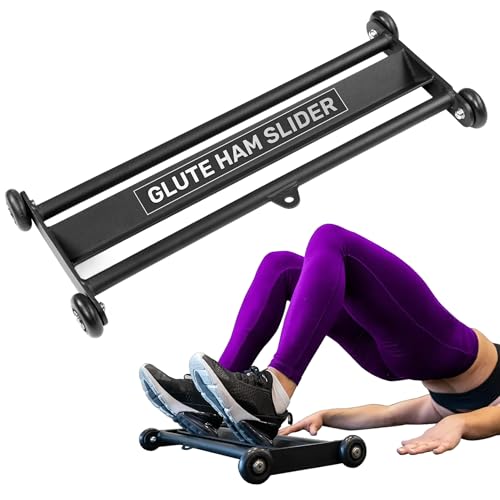
- Steel glider for hamstring, ab, and glute work
- Built-in handles and resistance-band hook
- Fully assembled and rated up to 440 pounds
Best For: Small home gyms and varied bodyweight training
Best High-Capacity Glider

- 600-pound maximum recommendation
- Four 3-inch urethane wheels for smooth rolling
- V-bar, handles, and band compatibility add versatility
Best For: Heavy-duty home or commercial glider workouts
Heavy-Duty Rack Attachment – Adjustable GHD for Power Cages
If you want a glute ham developer for home gym use without adding a completely separate station, this adjustable attachment is designed for a 3-by-3-inch power cage. Its 14 adjustment settings, substantial padding, and listed 800-pound capacity make it a versatile option for posterior-chain training.
Best For: Home gym owners with a compatible 3-by-3-inch power cage who want back extensions, hip extensions, GHD sit-ups, and related movements.
Pros:
- Heavy-duty alloy-steel construction with an 800-pound listed capacity.
- Fourteen adjustment settings help accommodate different users.
- Supports multiple exercises, including back extensions, hip extensions, Russian twists, and sit-ups.
- Large dual-layer pads, an 8-inch thigh cushion, and long grip handles add comfort and assistance.
Cons:
- Requires a compatible 3-by-3-inch power cage.
- Its attachment-style design may be less convenient than a standalone GHD for some layouts.
This is the most directly targeted choice for a home gym already built around a compatible power cage. Confirm rack dimensions and available space before buying, then use the adjustable settings to dial in a comfortable position.
Compact Core Trainer – CAP Strength Roman Chair
The CAP Strength Roman Chair is a practical alternative for shoppers comparing a glute ham developer for home gym training. It combines adjustable pads and footrests with a compact footprint, allowing back extensions, core work, and posterior-chain exercises in smaller workout spaces.
Best For: Home gym users who prioritize compact core, lower-back, glute, and hamstring training over a full dedicated GHD setup.
Pros:
- Steel-tubing construction provides a sturdy training base.
- Adjustable pads and footrests accommodate different body types.
- Supports back extensions, GHD sit-ups, side bends, twists, and hamstring raises.
- Its 39-pound weight and compact design suit smaller home gyms.
Cons:
- The listed maximum weight recommendation is 300 pounds, below the first product’s rating.
- It is a Roman chair rather than a dedicated GHD attachment.
- The supplied warranty is limited to 30 days.
This Roman chair makes sense when floor space and exercise variety matter most. It can cover many core and posterior-chain movements, though buyers seeking dedicated GHD functionality may prefer a more specialized design.
Space-Saving Glute Trainer – Lifepro GluteBlast Hip Thrust Machine
For shoppers who want a glute ham developer for home gym use that stores easily, the Lifepro GluteBlast emphasizes folding convenience. It functions as a hip thrust bench and sissy squat machine, with wheels, PU leather cushioning, and a listed 220-pound capacity.
Best For: Users focused on glute and hamstring work who need a foldable machine for a compact home gym.
Pros:
- Folds from a 45.3-by-27.2-by-21.3-inch open footprint to a smaller storage size.
- Built-in wheels make transport and storage easier.
- Supports hip thrusts, sissy squats, squats, lunges, planks, dips, and push-ups.
- Includes PU leather cushioning and a two-year manufacturer warranty.
Cons:
- The listed 220-pound capacity is lower than that of the heavy-duty GHD attachment.
- It is designed primarily around hip thrusts and sissy squats rather than dedicated GHD movements.
- Its foldable construction may not provide the same specialized setup as a full GHD.
The GluteBlast is a strong space-conscious option for glute-centered training. Choose it when folding storage and exercise variety are more important than a dedicated GHD platform or higher load rating.
Simple Standalone Station – Fitness First Glute Ham Developer
Fitness First Glute Ham Developer - Unisex Adult - Black - 63 x 40 x 45 inches
Check Price On AmazonThe Fitness First Glute Ham Developer is a straightforward standalone option for a home gym. Its solid-steel construction, foam padding, and rubber handle holds provide the basic structure for glute and hamstring work without relying on a power-cage attachment.
Best For: Buyers seeking a dedicated glute ham developer with a simple steel frame, padded support, and handles.
Pros:
- Solid-steel construction is designed for regular workout use.
- Foam padding supports more comfortable positioning.
- Rubber handle holds provide gripping points during exercises.
- The supplied notes specifically identify glute and hamstring training.
Cons:
- The supplied notes do not provide a weight-capacity rating.
- They also do not specify adjustment settings or a warranty.
- At 63 by 40 by 45 inches, it requires a dedicated floor area.
This model is worth considering if you prefer a standalone GHD and have enough room for its listed dimensions. Because the supplied details are limited, verify adjustability, capacity, and fit before committing to it for demanding training.
Adjustable Budget Pick – Roman Chair Back Extension Machine
If you want a versatile glute ham developer for home gym workouts without the footprint or weight of a commercial unit, this adjustable Roman chair is a practical option. It supports back extensions, sit-ups, glute work, hamstring training, stretches, incline push-ups, and dips, with a 330-pound maximum weight recommendation.
Best For: Home users who want an adjustable, multifunctional machine for core, glute, hamstring, and back exercises.
Pros:
- Seven-level length adjustment and five-level ankle-height adjustment accommodate different users.
- Dual ankle rollers, a reinforced footplate, and non-slip foot caps support steadier training.
- Includes push-up bars, a waist trainer, assembly tools, a manual, and a 24-month warranty.
Cons:
- At 35.6 pounds, it is considerably lighter than heavier commercial-style GHD machines.
- Its listed dimensions may still require dedicated floor space in a compact home gym.
This is a flexible choice for general home training, especially if adjustability and multiple exercise options matter more than a commercial-grade frame.
Commercial-Style Upgrade – Body-Solid SGH500B Glute and Hamstring Machine
The Body-Solid SGH500B is a substantial glute ham developer for home gym use, designed with multiple adjustments for glute-ham raises, reverse extensions, hip and back extensions, and GHD sit-ups. Its band pegs also let you add resistance tubes or bands for more training variety.
Best For: Users who want a heavy, highly adjustable lower-body machine suitable for demanding home or commercial-gym training.
Pros:
- Multiple vertical and horizontal adjustments help fit users of different heights and sizes.
- Band pegs support added resistance and progressive overload options.
- Thick DuraFirm knee and shin pads, oversized rollers, an integrated step, and transport wheels improve usability.
- Listed with a limited lifetime warranty and sturdy construction.
Cons:
- Its approximately 79-by-33-by-51-inch footprint requires significant floor space.
- The 136-pound listed machine weight makes repositioning more difficult than with lightweight models.
Choose this model when stability, adjustment range, padding, and resistance-band compatibility justify dedicating substantial space to a lower-body station.
Heavy-Duty Traditional Pick – Adjustable Roman Chair GHD
This traditional adjustable Roman chair is a straightforward glute ham developer for home gym training, with a heavy-gauge steel frame, a non-slip foot stand, and dense foam padding covered in stitched vinyl. Its adjustable design is intended to accommodate users of different heights.
Best For: Buyers seeking a durable, traditional GHD-style bench for indoor glute, hamstring, back, and hyperextension exercises.
Pros:
- Heavy-gauge steel tubing and powder coating support a durable frame.
- Adjustable construction helps accommodate different-height users.
- Non-slip footplate and dense foam padding provide a stable, supported setup.
Cons:
- Assembly is required.
- At 159 pounds, it is heavy and not especially convenient to move.
- The 60-by-36-by-44-inch dimensions require a dedicated workout area.
With its simple design and substantial weight, this model suits buyers who prioritize a traditional, durable station over portability or a long list of accessories.
Best Dedicated Glute Machine – Powerline Glute Master
If you want a dedicated glute ham developer for home gym training, the Powerline by Body-Solid PGM200X focuses on hip thrusts, glute bridges, and other lower-body movements. Its adjustable resistance, padded rollers, and fixed handles support customized glute, hamstring, and quad workouts.
Best For: Home users seeking a dedicated, stable machine for targeted glute training and adjustable resistance.
Pros:
- Designed for deep glute activation through hip thrusts and glute bridges
- Adjustable tension supports different fitness levels
- Plush pads and rollers are intended to improve comfort and positioning
- Supports up to 400 pounds and includes a 10-year in-home warranty
Cons:
- Its 66-by-26-by-60-inch footprint requires substantial home-gym space
- At 67 pounds, it is less convenient to move frequently
- It is a specialized machine rather than a compact multipurpose glider
The PGM200X is the more substantial choice for dedicated glute work. It makes the most sense when stability, padding, and a focused machine setup matter more than portability.
Best Compact Multi-Use Glider – Bells of Steel Glute Ham Glider
The Bells of Steel Glute Ham Glider is a compact glute ham developer for home gym users who want hamstring curls, abdominal work, and additional upper-body exercises from one steel device. Its wheels, handles, and resistance-band hook allow several training variations without a large machine footprint.
Best For: Space-conscious home gyms needing a portable glider for glute, hamstring, ab, and upper-body exercises.
Pros:
- Solid-steel construction is built for durability
- Smooth-gliding wheels support heel or toe placement
- Built-in handles enable glider, ab-roller, and push-tool movements
- Includes a hook for resistance bands or cables and arrives fully assembled
Cons:
- It does not provide the padded, fixed-position setup of a larger dedicated machine
- Resistance bands or cables are needed for added band-based intensity
- Its 11-pound design may feel less substantial than a stationary unit
This glider is a practical pick when versatility and easy storage take priority. Its 440-pound maximum recommendation adds useful capacity, while the compact design keeps it suitable for smaller training areas.
Best High-Capacity Glider – SELEWARE Glute Ham Glider
The SELEWARE Glute Ham Glider is a high-capacity glute ham developer for home gym or commercial use. Four 3-inch urethane wheels, a V-shaped center bar, side handles, and resistance-band compatibility support glute, hamstring, abdominal, and upper-body exercises.
Best For: Users who want a heavy-duty rolling glider with a 600-pound maximum recommendation and multiple exercise options.
Pros:
- Durable alloy-steel frame with black powder-coated finish
- Four urethane wheels are designed for smooth rolling
- V-shaped bar helps secure heels or toes during movements
- Supports resistance bands and is rated up to 600 pounds
Cons:
- Its larger 27.5-by-15-inch profile takes more storage space than a smaller glider
- It has no built-in weight-stack or adjustable plate-resistance system
- The listed design may require floor space for rolling exercises
Choose the SELEWARE when capacity and rolling stability are central requirements. The V-bar and four-wheel layout make it a versatile option for users who prefer a heavy-duty glider over a fixed machine.
How We Picked the Best Glute Ham Developer for Home Gym
We evaluated these machines by looking at the features that most affect safe, repeatable lower-body training at home. Key considerations included construction quality, stated weight capacity, pad and footplate adjustability, exercise versatility, stability during loaded movements, storage demands, and how well each design suits limited space. We also distinguished full GHD units from Roman chairs, hip-thrust machines, and gliders because they serve different training purposes.
Published specifications should be checked before purchase, especially dimensions, maximum user or load capacity, and the type of power cage or accessories required. A machine that fits your exercises but not your room is not a practical value.
Quick Comparison
- Full GHD machines: Best for glute-ham raises, Nordic-style work, back extensions, and progressive hamstring training.
- Roman chairs: A simpler choice for back extensions, oblique work, and bodyweight glute training.
- Hip-thrust machines: Better suited to focused glute loading, with less emphasis on hamstring-curl movements.
- Glute-ham gliders: Compact and versatile for hamstring curls, abdominal exercises, and mobile home gyms.
Key Buying Factors for a Glute Ham Developer for Home Gym
Footprint and Storage
Measure both the operating area and the storage footprint. Full-size GHDs need enough clearance for mounting, dismounting, and extending your legs, while foldable or gliding designs may work better in multipurpose rooms.
Adjustability and Fit
Look for adjustable hip pads, ankle rollers, footplates, or frame positions that accommodate your height and preferred exercises. Proper positioning helps keep the hips supported and reduces unwanted pressure during raises and extensions.
Stability and Capacity
A wide, rigid base is important when performing explosive or loaded movements. Compare the stated capacity with your body weight, added resistance, and expected progression. Band pegs, weight horns, or cage compatibility can expand training options but may also affect setup requirements.
Exercise Range
Decide whether you primarily want glute-ham raises, back extensions, hamstring curls, hip thrusts, or general core work. More versatile machines can replace several pieces of equipment, but simpler designs may offer better value if you need only one movement category.
Who Should Buy Which Glute Ham Developer for Home Gym?
Choose a full GHD if hamstring and posterior-chain development are central to your program and you have sufficient floor space. A Roman chair is a sensible pick for beginners or lifters who mainly want back extensions and core work. A hip-thrust machine suits users prioritizing direct glute loading and convenient setup. For apartments, shared rooms, or compact training areas, a glute-ham glider offers useful exercises with easier storage.
Whichever style you choose, prioritize a secure fit, stable frame, and manageable setup over extra features you are unlikely to use. That approach will help you select a Glute Ham Developer for Home Gym training that you can use consistently and progress with safely.