The best half squat racks make barbell training more accessible without requiring a commercial gym setup. The right choice depends on available space, rack stability, weight capacity, adjustability, and whether you want pull-up or cable-training features.
We compare 10 options ranging from straightforward squat stands to multifunctional home-gym cages, helping you match the equipment to your training style, room, and budget.
Best 10 Half Squat Racks Picks for 2026
Best Heavy-Duty Pick
FLYBIRD SR1 Adjustable Squat Rack

- 950-pound stated capacity
- 22 height settings with adjustable width
- Landmine, band pegs, and pull-up bar included
Best For: Lifters seeking a sturdy, versatile half rack for home training
Best Full-Size Upgrade
Sunny Health & Fitness Power Rack

- 18-point J-hook adjustment
- Built-in plate holders and pull-up bar
- Expandable with compatible attachments
Best For: Users with space for a complete, expandable home-gym rack
Best Adjustable Value
K KiNGKANG Adjustable Squat Rack

- 690-pound stated capacity
- 13 height and 10 width settings
- Two barbell storage racks included
Best For: Home gyms needing flexible dimensions and built-in storage
Best Compact Power Station

- 12- and 14-gauge steel frame
- Pull-up bar and adjustable bar catches
- Built-in storage and floor-anchor points
Best For: Home or garage gyms needing a basic rack with storage
Best Adjustable Half Squat Rack
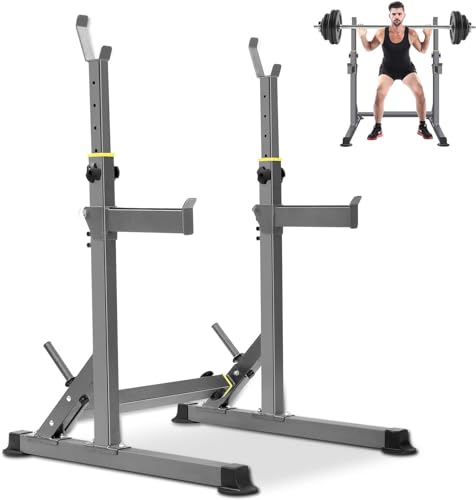
- 600-lb stated support for home strength training
- Adjustable width and height
- Foldable design for compact storage
Best For: Users needing a portable, adjustable rack for a home gym
Best All-in-One Half Squat Rack
RUNFREELY Smith Machine Trainer

- Combines rack and cable-training functions
- 1,000-lb stated rack capacity
- Includes pull-up, landmine, spotter, and storage features
Best For: Home gyms seeking a versatile multi-exercise station
Best Wall-Mounted Half Squat Rack

- Folds quickly to save floor space
- 1,000-lb stated capacity with 2-by-2-inch uprights
- Includes pull-up bar, J-cups, and safety catches
Best For: Wall-mounted home gyms with limited available floor area
Best Overall

- 1,500-lb stated cage capacity
- 28 J-hook and spotter-arm positions
- Pulley system and integrated storage
Best For: Versatile home-gym training
Best Space-Saving Pick
VEVOR Multifunctional Power Cage

- 17.7-square-foot stated footprint
- 1,000-lb stated total support
- Includes hooks, safety bars, and band pegs
Best For: Compact home gyms
Best Cable-System Pick

- 2,000-lb stated maximum recommendation
- Adjustable pulley system for cable exercises
- Includes landmine and multiple training bars
Best For: Cable-focused full-body workouts
Best Heavy-Duty Pick – FLYBIRD SR1 Adjustable Squat Rack
For lifters comparing half squat racks, the FLYBIRD SR1 stands out for its commercial-grade steel frame, 950-pound stated capacity, and broad adjustability. Its compact design fits 6-foot and 7-foot barbells while providing extended safety arms for solo training.
Best For: Home-gym users who want a sturdy, adjustable half rack with pull-up, landmine, and resistance-band options.
Pros:
- Supports up to 950 pounds with a reinforced 2-by-2-inch steel frame.
- Offers 22 height settings and adjustable width for different exercises and barbells.
- Includes 16.7-inch safety arms, a landmine attachment, band pegs, and a padded pull-up bar.
Cons:
- The supplied dimensions vary between the listed compact footprint and item dimensions, so verify available space before ordering.
- It is listed as a squat rack only and does not include a bench or barbell.
The SR1 is a versatile choice when stability and exercise variety matter more than having a fully enclosed rack. Its one-year warranty and included attachments add practical value for a growing home gym.
Best Full-Size Upgrade – Sunny Health & Fitness Power Rack
Although larger than many half squat racks, this Sunny Health & Fitness power rack is worth considering when you want a more complete strength-training station. It combines adjustable barbell supports with pull-up, band-workout, and plate-storage features.
Best For: Home-gym owners who have room for a full-size rack and want an expandable setup for squats, presses, pull-ups, and barbell training.
Pros:
- Supports squats, bench presses, shoulder presses, pull-ups, and full-body workouts.
- Provides 18-point J-hook adjustment, safety spotter arms, and an eight-position angled pull-up bar.
- Includes two built-in plate holders and supports compatible attachments for future expansion.
Cons:
- Its 38-by-53-by-87-inch footprint is larger than a typical compact half rack.
- Attachments are sold separately.
- The listed warranty is limited to one year or 180 days from the manufacturer.
This rack makes the most sense for a dedicated training area rather than a tight room. Its built-in storage and expandable design can help create a more complete home gym over time.
Best Adjustable Value – K KiNGKANG Adjustable Squat Rack
The K KiNGKANG rack offers the flexible sizing many shoppers want from half squat racks. Its height, width, and horizontal protection adjustments make it easier to configure for different exercises, while rubber feet help limit sliding and floor contact.
Best For: Home users who need a highly adjustable rack with integrated bar storage and a 690-pound stated capacity.
Pros:
- Supports up to 690 pounds and uses a 2-inch carbon-steel frame.
- Adjusts through 13 height levels and 10 width levels.
- Includes two barbell storage racks and removable cylinders for Olympic trap-bar storage.
Cons:
- The supplied notes do not specify a pull-up bar or other upper-body attachment.
- The maximum capacity is lower than the FLYBIRD model in this roundup.
- Its 79.9-inch height may be less suitable for users who prefer a taller rack.
With substantial width and height adjustability, this model is useful when multiple people share one rack or when workout positions vary. It is a practical option for flexible home setups where storage is also important.
Best Compact Power Station – CAP Power Rack Stand
The CAP Power Rack Stand is a compact power station for shoppers comparing half squat racks for a home or garage gym. It supports barbell catches, pull-ups, and bodyweight work while adding integrated storage and floor-anchor points for a more organized setup.
Best For: Lifters who want a straightforward steel rack with pull-up capability, storage, and anchoring features.
Pros:
- Uses 12- and 14-gauge steel with welded seams and double-gusseted uprights.
- Includes an overhead pull-up bar and adjustable bar catches.
- Provides integrated bar and plate storage plus floor-anchor points.
Cons:
- The supplied notes do not state the adjustment range for the bar catches.
- It has a shorter 30-day manufacturer warranty than some competing options.
- Floor anchoring may require additional setup in a home or garage gym.
The CAP is a sensible choice for basic barbell and bodyweight training when storage and stabilization are priorities. Its reinforced frame gives it a more substantial feel than a minimal stand, though the warranty is comparatively brief.
Best Adjustable Half Squat Rack – K KiNGKANG 600-lb Rack
If you need half squat racks for a compact home gym, the K KiNGKANG model emphasizes adjustability and portability. Its width adjusts from 27.9 to 47.2 inches, while the height ranges from 33.85 to 64.9 inches. The foldable design is suited to apartments, garages, and basements.
Best For: Home users who want an adjustable, foldable rack for squats, bench presses, and overhead lifts.
Pros:
- Steel frame is designed to support up to 600 pounds.
- Adjustable width and height accommodate different users and barbells.
- Foldable, space-saving design is easier to store between workouts.
- Supports several exercises, including squats, bench presses, and shoulder presses.
Cons:
- Its maximum height of about 65 inches may not suit every overhead exercise setup.
- The supplied details list both a 600-pound load claim and a 690-pound maximum capacity, so buyers should verify the applicable rating.
This is a practical choice when flexibility and storage matter more than a full cage setup. Confirm the load rating and available ceiling or floor space before ordering.
Best All-in-One Half Squat Rack – RUNFREELY Smith Machine Trainer
Among half squat racks, this RUNFREELY setup stands out for combining a squat rack with cable training and storage. The 46-by-67.7-inch footprint and 82.7-inch height provide a broad exercise platform, while the 2-by-2-inch steel frame has a stated 1,000-pound capacity.
Best For: Home gyms that want squats, presses, pull-ups, rows, and lat-pulldown exercises in one station.
Pros:
- Combines a half rack, lat pulldown, low row, and cable crossover functions.
- Includes J-hooks, spotter arms, pull-up bars, a landmine, and weight storage.
- Laser-cut adjustment markings help with attachment positioning.
- Six storage pegs can hold up to 1,200 pounds of plates according to the supplied notes.
Cons:
- Its 67.7-inch depth requires more floor space than a basic rack.
- The unit arrives in two packages that may be delivered separately.
- Assembly is more involved than with a simple squat stand because of the cable and storage components.
This is the most feature-rich option in the group, but its larger footprint and multi-package delivery should be planned for. It suits buyers prioritizing exercise variety over minimal setup.
Best Wall-Mounted Half Squat Rack – Mikolo Folding Power Rack
For limited-floor-space training areas, the Mikolo folding wall-mounted rack is a space-conscious alternative to freestanding half squat racks. It folds to roughly 47 by 2 by 85.8 inches and opens to about 47 by 19.7 by 85.8 inches, with a claimed 1,000-pound capacity.
Best For: Home gym users who can mount a rack securely to a wall and want fast storage after training.
Pros:
- Folds in about 15 seconds to help preserve floor space.
- 2-by-2-inch, 13-gauge steel uprights are designed for heavy training.
- Includes a pull-up bar, J-cups with UHMW plastic inserts, and safety catches.
- Stringer and metal studs are included for installation, with an estimated 15- to 30-minute setup.
Cons:
- It requires suitable wall mounting, so it is not as flexible as a freestanding rack.
- The open depth is nearly 20 inches, and the pull-up bar reaches about 89 inches, which may affect placement.
- Installation quality and wall structure are important for safe use.
This rack makes the most sense when preserving floor space is a priority and the mounting surface is appropriate. Measure the wall, ceiling clearance, and training area before installation.
Best Overall – SunHome Power Cage
For shoppers comparing half squat racks, the SunHome Power Cage stands out as a versatile home-gym centerpiece. It supports squats, bench presses, pull-ups, dips, and push-ups, while its pulley system and numerous adjustment points expand training options.
Best For: Lifters who want a feature-rich half rack with cable training, storage, and substantial stated capacity.
Pros:
- Supports up to 1,500 pounds for the power cage, according to the supplied specifications.
- Offers 28 adjustment positions for J-hooks and spotter arms.
- Includes a pulley system, dip handles, four plate-storage posts, and two barbell-storage hooks.
- Supports a broad range of exercises, including squats, bench presses, pull-ups, and dips.
Cons:
- At 84.9 inches tall, it may require careful ceiling-clearance planning.
- The supplied information lists a one-year warranty.
Its combination of adjustability, cable functionality, and integrated storage makes this a strong choice when you want more than a basic half squat rack.
Best Space-Saving Pick – VEVOR Multifunctional Power Cage
If floor space is a priority, this VEVOR model is one of the more compact half squat racks to consider. It covers 17.7 square feet while supporting squats, bench presses, pull-ups, and resistance-band work.
Best For: Home users seeking a compact, straightforward rack with included storage and training attachments.
Pros:
- Occupies a stated 17.7 square feet of floor space.
- Includes J-hooks, safety bars, a pull-up handle, band pegs, plate holders, and a barbell-storage hook.
- Provides 11 J-hook height settings and seven safety-bar settings.
- Uses a reinforced 2-by-2-inch carbon-steel main frame with a stated 1,000-pound capacity.
Cons:
- Weight plates are not included.
- It has fewer adjustment positions than some competing models in this roundup.
- At 59.8 pounds, its lighter construction may not feel as substantial as heavier racks.
The VEVOR is a practical option for smaller workout areas, especially if you want core rack functions and attachments without dedicating a large footprint.
Best Cable-System Pick – JELENS S11 Power Cage
Among these half squat racks, the JELENS S11 is especially appealing if cable exercises are central to your routine. Its adjustable pulley system supports lat pulldowns, seated rows, triceps extensions, and other movements alongside squats, presses, pull-ups, and landmine work.
Best For: Lifters wanting an all-in-one rack with a smooth adjustable pulley system and extensive training attachments.
Pros:
- Offers a stated 2,000-pound maximum weight recommendation.
- Includes an up-and-down pulley system with steel-shaft pulleys and a solid steel wire rope.
- Provides 13 marked height positions for quicker setup adjustments.
- Includes lat-pulldown, cable, T-bar, and pull-down bars, plus a landmine, J-hooks, safety rods, and storage racks.
Cons:
- The cage is shipped in two boxes, which may require coordinating delivery and assembly.
- Its 57.5-by-44.5-inch cage dimensions may still require dedicated floor space.
- The supplied warranty description is one year.
With its broad attachment package and compact stated footprint of 12.5 square feet, the S11 is a compelling choice for cable-focused full-body training at home.
How We Picked the Best Half Squat Racks
We focused on the features that matter most for home strength training: frame construction, stated weight capacity, height and width adjustability, barbell compatibility, safety hardware, footprint, storage, and included attachments. We also considered whether each rack supports more than squats, such as bench pressing, pull-ups, dips, lat pulldowns, or cable exercises.
Because listed capacities and real-world stability can vary, treat manufacturer ratings as a starting point rather than a guarantee. A rack should be placed on a level, suitable surface and used with compatible equipment and appropriate safety practices.
Quick Comparison
| Best For | Look For |
|---|---|
| Basic barbell training | Adjustable squat stands with secure J-hooks |
| Bench pressing and squats | Wide base, safety arms, and compatible bench height |
| Pull-up training | Integrated pull-up bar and reinforced frame |
| Full-body workouts | Lat pulldown, cable crossover, dip, or plate-storage attachments |
| Small rooms | Folding, wall-mounted, or compact freestanding designs |
Key Buying Factors for Half Squat Racks
Stability and Weight Capacity
Look for a broad footprint, solid uprights, secure hardware, and a capacity suited to your current lifting level with room for progression. Heavier racks generally offer more confidence during unracking, but they also require more floor space and careful assembly.
Adjustability and Safety
Multiple height positions help accommodate squats, overhead work, and bench pressing. Safety arms, spotter bars, or safety straps are especially important when training alone. Check the adjustment system and verify that pins or catches lock fully before loading a bar.
Footprint and Installation
Measure ceiling height, wall clearance, and usable floor area before ordering. Folding and wall-mounted models can save space, but they require suitable wall structure and correct installation. Freestanding cages may be easier to reposition but need enough room around the rack.
Attachments and Compatibility
Pull-up bars, dip handles, pulley systems, cable crossovers, and plate storage can expand your workouts, though they add cost, height, and assembly complexity. Confirm barbell length, bench dimensions, attachment compatibility, and whether weights or a bench are included.
Who Should Buy Which Half Squat Racks?
Choose a compact adjustable stand if you mainly squat, press, and bench and want the simplest setup. A power cage is a better fit for solo lifters who prioritize enclosed safety supports and more exercise options. Select a folding or wall-mounted rack when floor space is limited and secure installation is possible. For full-body training, a rack with pulleys, a lat attachment, or cable crossover can replace several separate stations, but make sure your room and budget support the larger setup.