Running parachutes can add adjustable drag to acceleration drills, helping athletes practice driving forward while building sprint-specific strength and power. The right chute should deploy reliably, stay comfortable during movement, and match the athlete’s size and training space.
We compare 10 popular resistance chutes for runners, football players, soccer athletes, and youth speed training, then explain the features that matter most before you buy.
Best 10 Running Parachutes for Sprint Training Picks for 2026
High-Resistance Pick
KUYOU 56-Inch Speed Training Chute

- Two chutes support up to 50 pounds of resistance
- Adjustable belt with 360-degree rotation
- Includes carrying bag and one-year warranty
Best For: High-resistance acceleration and explosive-power training
Trusted All-Rounder
SKLZ Speed Chute Resistance Parachute

- Provides 15 pounds of resistance
- Rotating belt supports movement in any direction
- Mesh panels help prevent tangling
Best For: Moderate-resistance acceleration and speed training
Simple Lightweight Option

- Medium 48-inch diameter
- Supports speed, stamina, strength, and acceleration work
- Includes a carrying bag
Best For: Basic portable resistance training for runners
Family-Friendly Fit
Bfsmile 56-Inch Adjustable Chute

- Offers approximately 12–33 pounds of resistance
- Fits 20- to 42-inch waists
- Lightweight with 360-degree directional movement
Best For: Kids, youth, and adults training acceleration together
Best All-Around Pick
56-Inch Powerchute Sprint Trainer

- 15–30 lb stated resistance range
- Adjustable belt and carry bag
- Waterproof cover with stabilizing mesh
Best For: Multi-sport athletes training acceleration and endurance
Best for Adjustable Resistance

- Advertised 25–50 lb resistance
- 360-degree rotating belt
- Quick-release buckle and carry bag
Best For: Explosive acceleration and change-of-direction drills
Best for Kids
48-Inch Youth Sprint Parachute

- Youth-oriented 48-inch design
- 360-degree belt for directional sprints
- Folds into a carrying bag
Best For: Kids practicing speed and acceleration drills
Best with Extra Features
56-Inch Adjustable Sprint Chute

- 15–30 lb dynamic drag
- 20–42 inch adjustable Velcro belt
- Lightweight, portable, mesh-supported design
Best For: Football, soccer, track, and portable sprint drills
Best for Multi-Sport Drills
56-Inch Speed Resistance Chute
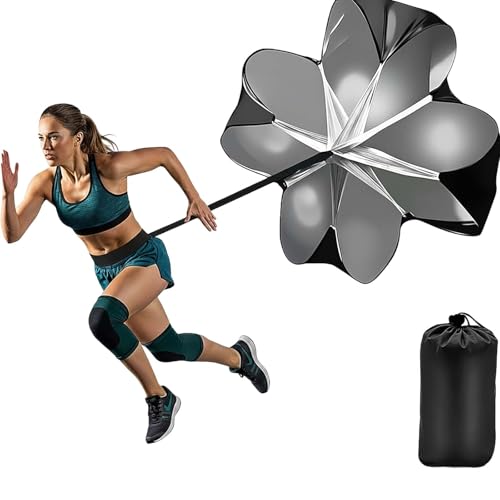
- 15–30 lb dynamic air resistance
- Adjustable 20–42 inch Velcro belt
- Waterproof, UV-resistant, portable construction
Best For: Multi-sport speed, agility, and interval training
Best for High-Resistance Workouts

- Two canopies with 25–50 lb resistance
- 360° omnidirectional training design
- Quick-release buckle and anti-tangle mesh
Best For: High-resistance sprint and multi-directional training
High-Resistance Pick – KUYOU 56-Inch Speed Training Chute
If you want running parachutes for sprint training with more resistance, the KUYOU 56-inch model uses two umbrella-style chutes and supports up to 50 pounds of tension. Its adjustable belt and directional design make it suitable for acceleration work across several sports.
Best For: Athletes seeking adjustable, high-resistance sprint and explosive-power training.
Pros:
- Two chutes provide up to 25–50 pounds of resistance.
- Adjustable 2-inch nylon belt fits almost any athlete.
- 360-degree rotating belt supports changes of direction.
- Includes a carrying bag and one-year warranty.
Cons:
- Its higher resistance may be more than beginners need.
- The two-chute setup may be less convenient than a single chute.
Choose this model when resistance capacity and multidirectional movement matter more than keeping the setup minimal. It is a versatile option for track, football, soccer, basketball, and general fitness training.
Trusted All-Rounder – SKLZ Speed Chute Resistance Parachute
SKLZ Speed Chute Resistance Parachute for Speed and Acceleration Training Grey / Black, 54-Inch
Check Price On AmazonThe SKLZ Speed Chute is a straightforward choice among running parachutes for sprint training, offering 15 pounds of resistance for acceleration and top-speed work. Its rotating belt, quick-release buckle, and mesh panels focus on practical solo training.
Best For: Athletes who want a single, moderate-resistance chute for multidirectional speed work.
Pros:
- Designed for acceleration and top-running-speed training.
- 360-degree belt rotation allows movement in any direction.
- Quick-release buckle supports acceleration bursts.
- Mesh panels help reduce string tangling and stabilize the chute.
Cons:
- Provides only one resistance level and supports 15 pounds.
- No warranty is listed in the supplied details.
This is a sensible, uncomplicated option for multi-sport athletes who prefer moderate resistance and useful handling features. The built-in mesh panels may be especially helpful during repeated training sessions.
Simple Lightweight Option – LucaSng 48-Inch Power Chute
For runners looking for a compact approach to running parachutes for sprint training, the LucaSng 48-inch chute is built for speed, stamina, strength, and acceleration work. It uses parachute cloth and netting and includes a carrying bag.
Best For: Runners wanting a basic, portable resistance chute for general speed training.
Pros:
- 48-inch diameter provides a medium-sized training surface.
- Designed to support speed, stamina, strength, and acceleration.
- Made from parachute cloth and netting.
- Includes a handy carrying bag.
Cons:
- The supplied details do not specify a resistance rating.
- Fewer belt and adjustment features are listed than on some alternatives.
The LucaSng is a practical pick if you want a focused, easy-to-carry chute without relying on a long list of extras. Consider it when basic running resistance training is the priority.
Family-Friendly Fit – Bfsmile 56-Inch Adjustable Chute
The Bfsmile 56-inch chute is a flexible choice for running parachutes for sprint training, with a stated resistance range of 12–33 pounds and an adjustable waist belt for 20- to 42-inch waists. Its lightweight design is intended for kids, youth, and adults.
Best For: Families and mixed-age training groups needing an adjustable chute for acceleration work.
Pros:
- Produces approximately 12–33 pounds of resistance as speed increases.
- Adjustable belt fits waists from 20 to 42 inches.
- 360-degree metal D-ring supports sprinting in any direction.
- Lightweight design includes a carrying bag.
Cons:
- Only one 56-inch chute and one bag are included.
- Hand-wash care may require extra maintenance.
This model stands out for its broad fit range and manageable weight. It is a good match for shared equipment or developing athletes who need adjustable resistance for track and other acceleration-focused sports.
Best All-Around Pick – 56-Inch Powerchute Sprint Trainer
For athletes comparing running parachutes for sprint training, this 56-inch model combines adjustable resistance, portability, and features designed for multidirectional drills. Its stated 15–30 pounds of resistance can support acceleration, stride, and endurance work across several sports.
Best For: Track, football, soccer, basketball, and other athletes seeking a versatile sprint-resistance chute.
Pros:
- Provides approximately 15–30 pounds of resistance for speed and strength training.
- Adjustable belt is designed to fit almost any athlete.
- Waterproof, sun-blocking, quick-drying cover with a stabilizing mesh panel.
- Includes a portable training bag for easier storage and transport.
Cons:
- Its 56-inch size may be more equipment than younger or smaller athletes need.
- The listed resistance range may be less challenging for highly advanced athletes.
This is a practical choice when you want one durable, easy-to-carry chute for regular sprint drills and sport-specific acceleration work.
Best for Adjustable Resistance – KUYOU 56-Inch Speed Chute
The KUYOU speed chute is a strong option for running parachutes for sprint training when you want a rotating belt and quick-release setup. Its 56-inch design is listed with 25–50 pounds of resistance, while the free-motion ring supports direction changes during high-speed running.
Best For: Athletes practicing acceleration bursts, directional changes, and explosive power across field and track sports.
Pros:
- Advertised resistance range of 25–50 pounds for demanding speed work.
- 360-degree rotating belt and free-motion ring allow multidirectional training.
- Adjustable heavy-duty nylon belt includes a quick-release buckle.
- Includes a carrying bag and a one-year warranty description.
Cons:
- The product details list both 25–50 pounds and 25–35 pounds as resistance figures, so the exact range is unclear.
- Higher resistance may be excessive for beginners without gradual progression.
Choose this model if belt mobility and harder acceleration resistance matter more to you than a minimal training setup.
Best for Kids – 48-Inch Youth Sprint Parachute
For younger athletes looking at running parachutes for sprint training, this 48-inch chute offers a smaller format that is easy to fold, carry, and use outdoors. The rotating belt supports sprinting in different directions, while the parachute’s resistance increases as running speed rises.
Best For: Kids and youth soccer or football players practicing speed, stamina, and acceleration.
Pros:
- 48-inch size is positioned for kids and youth training.
- 360-degree rotating belt supports sprints in any direction.
- Polyester parachute cloth and netting are described as waterproof, sun-blocking, and quick-drying.
- Folds into the included carrying bag for outdoor portability.
Cons:
- The product details provide limited information about a specific resistance range.
- Its youth-oriented size may not provide enough drag for larger or advanced adult athletes.
This is the most age-targeted option in the group and makes sense for supervised youth drills where compact storage and simple setup are priorities.
Best with Extra Features – 56-Inch Adjustable Sprint Chute
For athletes comparing running parachutes for sprint training, this 56-inch model offers a practical balance of resistance, portability, and fit. It is designed to create approximately 15–30 pounds of drag while its adjustable belt accommodates 20- to 42-inch waists.
Best For: Football, soccer, track, and portable solo or team sprint drills.
Pros:
- Generates approximately 15–30 pounds of dynamic drag to support acceleration and explosive-power work.
- Adjustable Velcro belt fits 20- to 42-inch waist sizes and is designed to stay secure during movement.
- Weather-resistant nylon, a mesh panel, and a 160-gram weight support organized, portable training.
Cons:
- The notes do not list a warranty.
- Resistance is presented as a range rather than a selectable setting.
Choose this chute if you want a lightweight, straightforward option for field or park workouts. Its adjustable belt and tangle-reducing mesh make it especially convenient for repeated sprint sessions.
Best for Multi-Sport Drills – 56-Inch Speed Resistance Chute
This 56-inch chute is a versatile choice for running parachutes for sprint training, with approximately 15–30 pounds of air resistance for acceleration, speed, and endurance drills. Its adjustable belt and compact carrying pouch make it suitable for both individual and team sessions.
Best For: Athletes training across football, soccer, basketball, skating, lacrosse, and similar sports.
Pros:
- Designed to provide approximately 15–30 pounds of dynamic resistance for speed and strength work.
- Adjustable Velcro belt fits 20- to 42-inch waists and supports multidirectional drills.
- Waterproof, UV-resistant, quick-drying nylon and a built-in grid panel help limit tangling.
- Lightweight 160-gram construction folds into the included pouch for transport.
Cons:
- The notes do not specify a warranty.
- Adding multiple parachutes is suggested, but the product details do not explain how resistance scales precisely.
This model stands out for training versatility. It is a sensible pick when your workouts move between sports, agility patterns, and sprint intervals rather than focusing on one event.
Best for High-Resistance Workouts – Dual 56-Inch Parachute System
For athletes seeking more resistance from running parachutes for sprint training, this system uses two 56-inch canopies to provide an advertised 25–50 pounds of resistance. The dual-chute setup is intended for explosive acceleration and multidirectional training.
Best For: Advanced or high-resistance sprint sessions in football, basketball, track and field, rugby, and related sports.
Pros:
- Two canopies offer a stated 25–50-pound resistance range for demanding acceleration work.
- 360-degree omnidirectional design supports varied movement and sprint-training patterns.
- Waterproof, UV-resistant, tear-resistant material and built-in anti-tangle mesh are designed for repeated use.
- Quick-release safety buckle supports fast removal during intense drills.
Cons:
- At 0.38 kg, it is heavier than the listed single-chute options.
- The higher resistance may be excessive for beginners or lighter training sessions.
- The notes do not list a warranty.
This is the strongest option in the group when your priority is substantial, adjustable resistance. Consider it when a single 15–30-pound chute does not provide enough challenge for your training plan.
How We Picked the Best Running Parachutes for Sprint Training
We focused on the factors that affect real training sessions: canopy size, resistance design, belt and strap adjustability, construction quality, portability, and suitability for different ages and sports. We also considered whether each chute appears practical for repeated acceleration work rather than occasional novelty use.
Because product specifications can vary by seller, verify the listed dimensions, included accessories, and adjustment range before ordering. A carry bag is useful for athletes who travel to fields or tracks, while a secure waist belt is essential for drills involving sharp acceleration.
Quick Comparison
| Best For | What to Look For |
|---|---|
| General sprint training | Medium canopy, adjustable belt, durable seams |
| Youth athletes | Smaller or moderate resistance and a comfortable adjustable strap |
| Football and soccer | Secure attachment, strong webbing, and easy portability |
| Travel and team use | Compact folding design and included storage bag |
Key Buying Factors for Running Parachutes for Sprint Training
Canopy Size and Resistance
Larger canopies generally create more drag, but maximum resistance is not always best. Sprint parachutes should challenge acceleration without forcing poor posture, shortened strides, or excessive leaning. Beginners and younger athletes may benefit from a moderate-size chute, while stronger athletes can choose a larger model if the belt and attachment points are well made.
Fit and Adjustability
Look for an adjustable waist belt that stays secure without restricting breathing or hip movement. The chute should sit comfortably during starts, resisted runs, and changes of direction. Adjustable straps are especially important when equipment is shared by multiple athletes.
Durability and Deployment
Inspect the canopy fabric, stitching, swivel or tether connection, and belt webbing. A chute that tangles easily or fails to open consistently can interrupt training. Bright colors may also improve visibility when working around teammates.
Training Environment
Use resistance chutes on open, relatively smooth surfaces with enough room to slow down safely. Wind can substantially increase drag, so outdoor conditions should influence the workout intensity. These tools complement—not replace—proper warmups, sprint mechanics, strength work, and recovery.
Who Should Buy Which Running Parachutes for Sprint Training?
Choose a moderate, adjustable model for general runners and beginners learning resisted acceleration. Youth athletes should prioritize a comfortable fit and manageable drag over the largest available canopy. Football and soccer players should select a durable chute with a secure belt for repeated field drills. Competitive sprinters and stronger athletes may prefer a larger 56-inch design, provided they can maintain efficient mechanics under resistance. If you frequently train away from home, prioritize compact folding, a carry bag, and hardware that is easy to inspect and replace.