A compact home gym does not have to limit your strength training. The best squat racks for small spaces provide dependable bar support while folding, adjusting, or separating to preserve valuable floor area.
We selected 10 options ranging from wall-mounted folding racks to portable squat stands and full power cages, with attention to capacity, footprint, setup flexibility, and everyday usability.
Best 10 Squat Racks for Small Spaces Picks for 2026
Best Wall-Mounted Power Rack

- Folds to a 2-inch-wide stored profile
- Includes pull-up bar, J hooks, and landmine
- Supports up to 1,100 pounds
Best For: Wall-mounted home gyms needing maximum floor savings
Best Adjustable Half Rack

- Fits most 6-foot and 7-foot barbells
- Provides 22 height adjustments
- Includes safety arms and multiple attachments
Best For: Compact rooms needing an adjustable, versatile half rack
Best Quick-Folding Rack
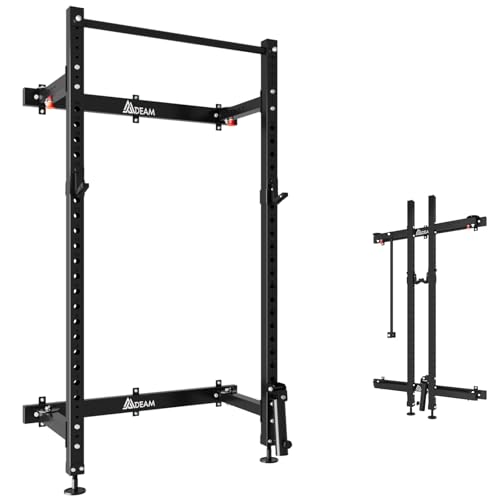
- Folds and unfolds in about 15 seconds
- Supports up to 1,000 pounds
- Includes leveling feet and three key attachments
Best For: Small gyms needing quick storage and wall-mounted stability
Best Freestanding Budget Stand

- Adjusts in both height and width
- Supports up to 600 pounds
- H-shaped base helps improve stability
Best For: Basic home barbell training without wall installation
Best Wall-Mounted Pick

- Folds to about 2 inches wide
- Includes pull-up, landmine, and safety attachments
- Listed capacity up to 1,000 pounds
Best For: Wall-mounted home gyms prioritizing maximum floor-space savings
Best Portable Option
JX FITNESS Adjustable Squat Rack

- Five height and four width adjustments
- Foldable for apartments and basements
- Supports up to 660 pounds
Best For: Compact home gyms needing adjustable, storable equipment
Best Full-Function Cage
VEVOR Multifunctional Power Cage

- Includes safety, storage, band, and landmine attachments
- Offers 22 adjustment holes and five width settings
- Listed footprint is 20.1 square feet
Best For: Compact home gyms wanting a versatile cage-style setup
Most Adjustable

- 13 height positions and 10 width settings
- 690-pound listed maximum capacity
- Includes removable barbell storage racks
Best For: Lifters needing flexible positioning for varied home workouts
Best Traditional Pair
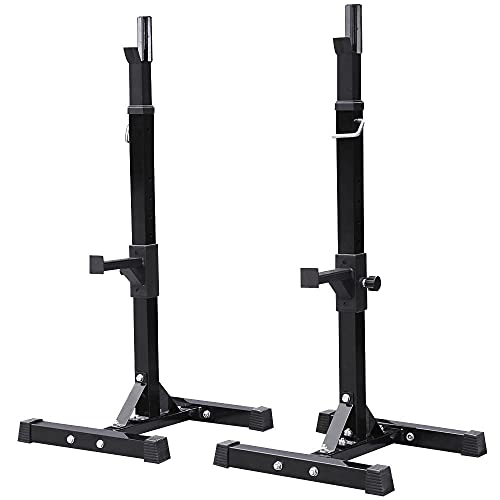
- Two separate stands save setup space
- 14 safety-pin positions per post
- 550-pound listed maximum capacity
Best For: Home users wanting portable stands for squats and bench presses
Best Lightweight Option
Portable Adjustable Squat Rack
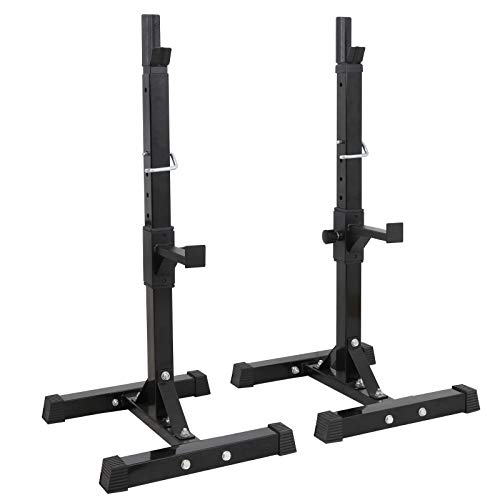
- 17.7-by-20.1-inch compact footprint
- 13 adjustable safety-spotter positions
- 18.5-pound portable design with 550-pound capacity
Best For: Small home gyms prioritizing portability and storage
Best Wall-Mounted Power Rack – MU Folding Squat Rack
If you need squat racks for small spaces, the MU folding rack is designed to keep the floor clear. It mounts to a wall, folds to just 2 inches wide for storage, and supports squats, presses, pull-ups, and other exercises.
Best For: Home gyms, garages, and training spaces that need a heavy-duty rack with minimal floor use.
Pros:
- Folds from a 21.8-inch-wide setup to a 2-inch-wide stored profile.
- Includes J hooks, an adjustable pull-up bar, and a detachable 360-degree landmine.
- Uses heavy-duty steel and is rated for up to 1,100 pounds.
- Universal 1-inch workout holes support compatible accessories.
Cons:
- Requires suitable wall mounting for proper support.
- Its 85.8-inch height may not suit rooms with low ceilings.
This is one of the more capable options for compact training areas, especially if you want a full range of attachments without sacrificing permanent floor space.
Best Adjustable Half Rack – FLYBIRD SR1 Squat Rack
For shoppers comparing squat racks for small spaces, the FLYBIRD SR1 combines a compact footprint with adjustable positioning. Its width accommodates most 6-foot and 7-foot barbells, while 22 height settings help tailor the rack for different lifts.
Best For: Home gyms, basements, or garages where you want a versatile half rack without a full power-cage footprint.
Pros:
- Compact design measures approximately 39 inches long by 41.3 inches wide by 83 inches high.
- Supports up to 950 pounds with 2-by-2-inch commercial-grade steel.
- Offers 22 height settings and 16.7-inch safety arms for solo training.
- Includes a landmine, six resistance-band pegs, and a padded pull-up bar.
Cons:
- It is a half rack rather than a folding or fully enclosed power rack.
- The stated dimensions vary between the product description and specifications.
The SR1 is a practical middle ground: it delivers substantial adjustability and exercise variety while keeping its footprint relatively controlled.
Best Quick-Folding Rack – MDEAM Wall-Mounted Squat Rack
The MDEAM is a strong candidate among squat racks for small spaces because it folds for storage and can be switched between stored and usable positions in about 15 seconds. Wall mounting and leveling feet help keep the setup stable during training.
Best For: Home gyms, garages, and basements where fast storage and a compact wall-mounted design are priorities.
Pros:
- Folds for storage and opens to a 25-by-44-by-87-inch configuration.
- Uses 60-by-60-millimeter steel uprights and supports up to 1,000 pounds.
- Includes stabilizer leveling feet for uneven floors or slightly imperfect mounting.
- Comes with J hooks, a pull-up bar, and a 360-degree landmine.
Cons:
- Wall installation is required, with an estimated installation time of 15 to 30 minutes.
- Its 87-inch height may be too tall for some rooms.
With quick folding, substantial weight capacity, and included attachments, this rack suits users who want a space-conscious setup that can be put away between workouts.
Best Freestanding Budget Stand – CANPA Adjustable Squat Rack
If wall mounting is not practical, the CANPA offers a simpler freestanding alternative for squat racks for small spaces. Its adjustable height and width let it serve as a squat, bench press, or overhead lifting stand while keeping the design more open than a cage.
Best For: Home users who need a movable-style freestanding rack for basic barbell exercises and bench work.
Pros:
- Adjusts from 35.1 to 41.8 inches wide and from 50 to 57 inches high.
- Supports up to 600 pounds with a 2-by-2-inch steel frame.
- H-shaped bases and nonslip foot covers help improve stability and protect floors.
- Includes two barbell storage racks and six height adjustment levels.
Cons:
- Its 600-pound capacity is lower than the other racks in this roundup.
- It does not include a pull-up bar, landmine, or folding wall-mount design.
- The nuts require two wrenches for proper tightening.
The CANPA is best suited to straightforward barbell training where a compact, adjustable stand is more useful than a feature-heavy power rack.
Best Wall-Mounted Pick – RitFit Folding Squat Rack
For shoppers comparing squat racks for small spaces, the RitFit PMW02 stands out for its wall-mounted folding design. It opens to 47″L x 19.7″W x 85.5″H and folds to roughly 2 inches wide, helping clear floor space after training. It supports squats, bench presses, pull-ups, and more, with a listed capacity of up to 1,000 pounds.
Best For: Home gyms that need a heavy-duty rack that can fold against the wall between workouts.
Pros:
- Folds away to minimize its footprint.
- Includes J-hooks, a pull-up bar, landmine, and safety arm.
- Uses 60mm x 60mm uprights made from 1.8mm-thick steel.
- Wall mounting can help limit rack movement during training.
Cons:
- Requires wall installation and careful drilling preparation.
- Not intended for weight-bearing walls, according to the supplied notes.
The RitFit is the most space-conscious option here, especially when floor space matters more than portability. Plan the mounting location carefully, then take advantage of its broad exercise selection and included attachments.
Best Portable Option – JX FITNESS Adjustable Squat Rack
The JX FITNESS adjustable rack is a practical choice for apartments, garages, and basements where equipment may need to be stored after use. Its height adjusts across five levels from 41 to 57 inches, while the width adjusts from 25 to 40 inches. The foldable design and 660-pound capacity make it a flexible option among squat racks for small spaces.
Best For: Lifters who want an adjustable, multipurpose rack that can be folded and stored between sessions.
Pros:
- Offers five height and four width settings.
- Foldable design suits compact home workout areas.
- Functions as a squat, barbell, and bench press rack, plus a push-up station.
- Supports up to 660 pounds.
Cons:
- Its listed dimensions are 48″D x 44″W x 60″H, so it still needs setup room when open.
- Provides less stated capacity than the RitFit and VEVOR options.
This JX FITNESS model emphasizes adjustability and storage convenience rather than a full cage structure. It is a sensible fit for users who share workout space or need to adapt the rack to different exercises and lifter heights.
Best Full-Function Cage – VEVOR Multifunctional Power Cage
The VEVOR power cage packs several strength-training stations into a footprint listed at 20.1 square feet, making it worth considering when you want broad functionality without a sprawling setup. It supports squats, bench presses, pull-ups, landmine rows, and more, while offering adjustable width settings and multiple J-hook and safety-bar positions.
Best For: Home lifters who want a more complete power-cage setup while keeping the equipment footprint relatively contained.
Pros:
- Includes J-hooks, safety bars, band pegs, plate storage, pull-up handle, and landmine attachment.
- Provides 22 adjustment holes and five width settings from 58.2 to 62.3 inches.
- Uses a reinforced 2″ x 2″ main frame.
- Supports a wide range of full-body strength exercises.
Cons:
- Its 69.3-inch listed width requires more floor space than the other two options.
- Weight plates are not included.
- The supplied details list both 980 pounds in the description and 440 pounds as the maximum capacity field, so buyers should verify the applicable rating.
The VEVOR is the most feature-rich choice, but it is not the most compact in absolute dimensions. Compare the available floor area with its listed width and confirm the capacity specification before ordering.
Most Adjustable – Compact Home Gym Squat Rack
If you need squat racks for small spaces but still want broad positioning options, this KiNGKANG rack offers adjustable height and width. Its steel frame, rubber feet, and integrated storage make it a flexible choice for home strength training.
Best For: Lifters who want one adjustable rack for squats, presses, overhead lifts, and other home-gym exercises.
Pros:
- Height adjusts across 13 positions from 36.2 to 60 inches.
- Width adjusts across 10 levels, from 29.9 to 46.3 inches.
- Thick steel tubing, rubber feet, and a listed 690-pound capacity support a stable setup.
- Includes two removable barbell storage racks.
Cons:
- Its maximum listed dimensions reach 46.4 inches wide and 79.9 inches high.
- The broad adjustment system may be more than casual users need.
This is the most versatile option in the group, especially when multiple users or exercises require different rack positions. Measure your available height and width before buying.
Best Traditional Pair – Adjustable Barbell Stands
For shoppers comparing squat racks for small spaces, this Yaheetech pair uses two separate stands rather than a single large frame. The adjustable posts and anti-skid feet make it practical for squats and bench presses in a home gym.
Best For: Home users who prefer portable, separate barbell stands with straightforward height adjustment.
Pros:
- Each post has 14 adjustable safety-pin positions.
- Height adjusts from 44 to 70 inches.
- 50 mm steel tubing and a listed 550-pound maximum support strength training.
- Anti-skid feet help limit movement and protect the floor.
Cons:
- The separated stands require careful positioning before each exercise.
- Nuts need to be fully tightened with a wrench rather than by hand.
- The 44-inch minimum height may not suit every bench setup.
This pair is a space-conscious choice when you value adjustability and easy repositioning. Its separate-stand design can be useful in tighter rooms, provided you set both sides evenly and secure the hardware.
Best Lightweight Option – Portable Adjustable Squat Rack
Among squat racks for small spaces, the F2C stands out for its compact 17.7-by-20.1-inch footprint and lightweight 18.5-pound design. It supports standard and Olympic barbells while providing adjustable spotter arms for different users and movements.
Best For: Space-limited home gyms that need a portable rack for squats, bench presses, and general strength training.
Pros:
- Compact footprint fits smoothly into smaller workout areas.
- Height adjusts from 40 to 66 inches.
- 13 safety-spotter positions help customize the catch height.
- Anti-skid rubber pads help stabilize the rack and protect flooring.
Cons:
- Its listed 550-pound capacity is lower than the KiNGKANG model’s rating.
- The compact, lightweight construction may be less substantial than heavier rack designs.
- Connections should be fully tightened with a wrench for security.
This is a practical pick when storage and portability matter most. Its compact dimensions and adjustable spotters offer useful versatility, while the H-style base and rubber pads help keep the setup steady during training.
How We Picked the Best Squat Racks for Small Spaces
We compared these racks by looking at the features that matter most when floor space is limited: storage footprint, adjustment range, stated weight capacity, stability, attachment options, and compatibility with common barbell lengths. Wall-mounted folding models can offer the best space savings, but they require a suitable wall and careful installation. Freestanding stands are easier to reposition, while power cages generally provide more exercise options at the cost of a larger footprint.
Because listed capacities and construction details vary by manufacturer, treat the published load rating as a maximum guideline rather than a guarantee of performance in every setup. Always verify mounting hardware, floor conditions, and included accessories before use.
Quick Comparison
| Rack type | Best for | Main advantage | Key limitation |
|---|---|---|---|
| Folding wall-mounted rack | Dedicated home gyms | Folds close to the wall | Requires secure installation |
| Adjustable squat stand | Flexible layouts | Portable and easy to store | Usually less integrated than a cage |
| Power cage | Versatile strength training | Supports squats, presses, and pull-ups | Uses more floor and ceiling space |
| Pair of barbell stands | Basic lifting setups | Often the simplest low-cost option | May offer less lateral stability |
Key Buying Factors for Squat Racks for Small Spaces
Available Floor and Ceiling Clearance
Measure the rack’s operating footprint, not just its folded or stored dimensions. Leave room to load plates, walk around the bar, and perform pull-ups if included. Check ceiling height before choosing a cage or tall rack.
Mounting and Stability
Wall-mounted racks need solid structural support and appropriate hardware. Freestanding models should have a broad base, secure adjustment points, and enough weight or anchoring to resist rocking during unracking and re-racking.
Capacity and Adjustability
Choose a rack whose stated capacity comfortably exceeds your current working load. Multiple height positions help accommodate squats, bench presses, and different users. Confirm that the rack fits your barbell, especially if you use a six-foot bar.
Attachments and Storage
Pull-up bars, J-hooks, safety arms, and landmine attachments can expand a compact setup’s usefulness. However, accessories also add cost and may increase clearance requirements, so prioritize only the functions you will use.
Who Should Buy Which Squat Racks for Small Spaces?
Choose a folding wall-mounted model if your main priority is reclaiming floor space after training and you can install it securely. Select an adjustable squat stand if you need portability, quick repositioning, or storage in a closet or corner. A power cage is the better choice for lifters who want integrated pull-ups and more comprehensive safety features and have enough room to keep it assembled. For occasional bench pressing or lighter home workouts, a pair of adjustable stands may provide the simplest practical solution.